
A Lighthouse in the Fog
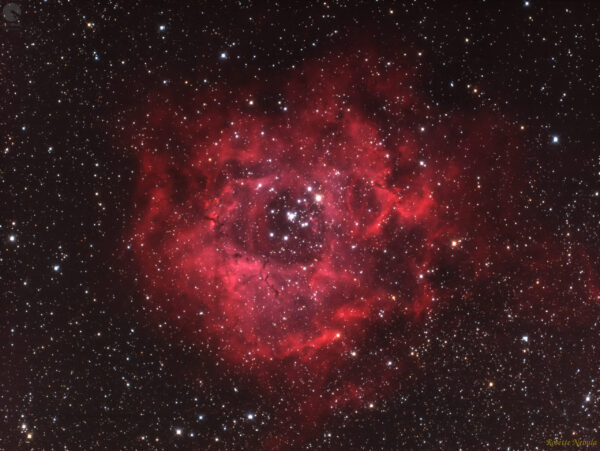
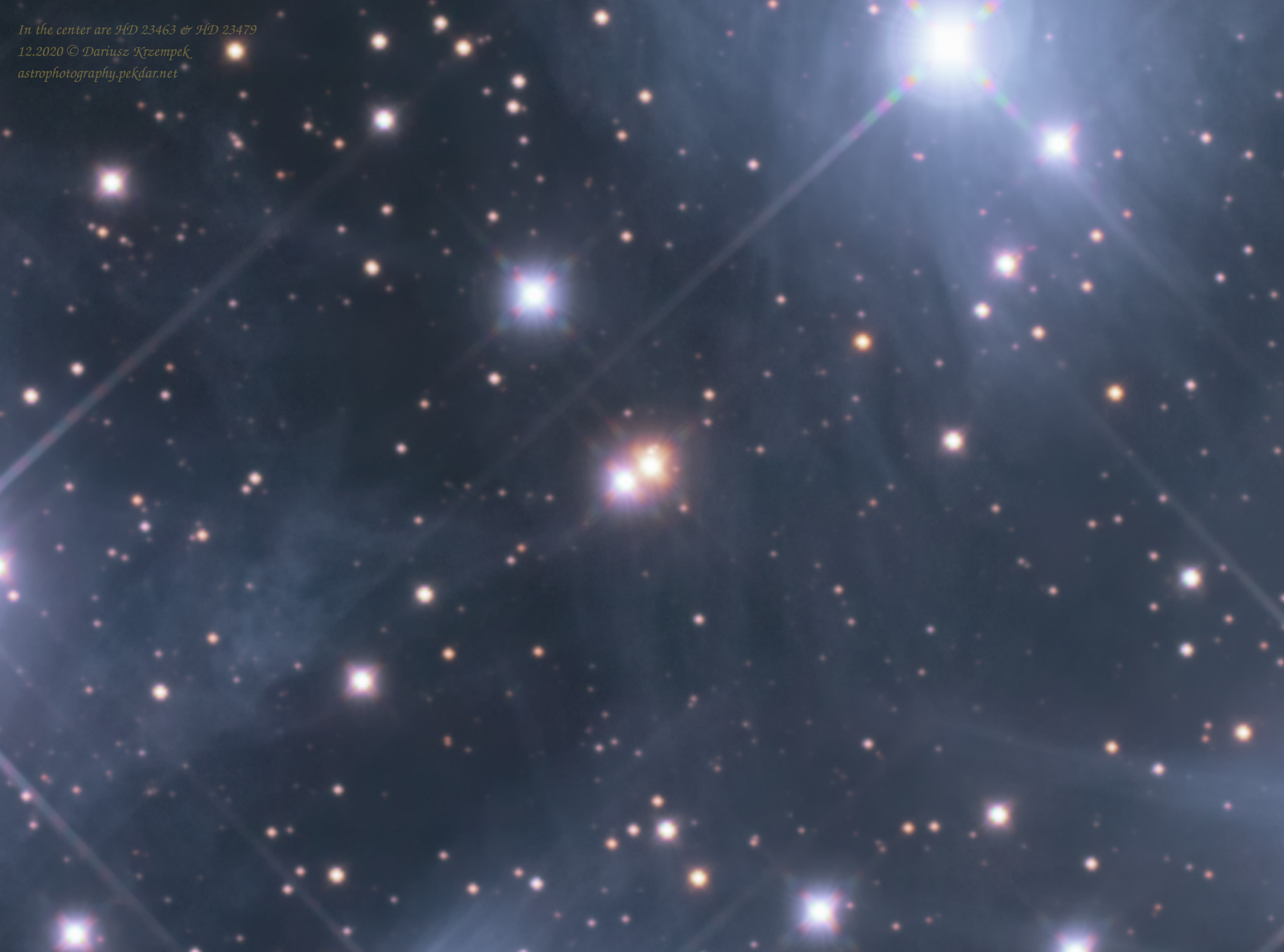
This image reveals a fragment of one of the most dynamic regions of the M45 cluster (The Pleiades). While the bright stars draw the eye, the key engineering and physical object here is the matter surrounding them – The Merope Nebula (NGC 1435). The smaller stars visible in the frame, identified as HD 23463 (spectral type K2) and HD 23479 (type B9), serve as excellent reference points for analyzing the density and structure of the surrounding dust clouds.
The Physics
Why Blue? This area is a textbook example of a reflection nebula. Unlike emission nebulae (which emit their own light, typically red from H-alpha hydrogen), here we observe a scattering mechanism.
-
Carbon and silicate dust grains act like billions of microscopic mirrors.
-
Light from the nearby, powerful star Merope (just outside the frame or at the edge) is scattered.
-
Shorter wavelengths (blue) are scattered much more efficiently than red ones (a phenomenon identical to what gives Earth’s sky its blue color).
Image and Structure Analysis
Stars HD 23463 and HD 23479 appear to be “suspended” in a delicate mist. In reality, the Pleiades are currently “passing through” an unrelated cloud of interstellar dust with a relative velocity of about 11 km/s. In the image, note the filamentary structure of the nebula. These filaments align with magnetic field lines and are shaped by the radiation pressure of nearby B-type giants. Capturing these subtle striations required high local contrast and precise denoising to avoid destroying detail in the shadows.
Star HD 23463
Look into the enlarged corner photo the star one above is orange. Distance from earth: 432.24 light years. The star surface temperature is estimated in the range of 3700–5200 [K]. It does not belong to the constellation Taurus, its close on its border. Invisible for the naked eye, you need binoculars or a telescope to see it.
Star spectral class: K2 – its mass relative to the sun is 0.45 to 0.8 . So, it is “smaller” than our sun. The number of stars of this class is in the 12%, of the main sequence, so when we look on the sky, these stars occur quite frequently. When we look at the spectrum of a star, we will notice that these types of stars, have significant metal lines, where in astronomy we call metal with element heavier than helium.
Star HD 2347
It is a variable, eruptive star, blue in color. Distance from earth: 440.76 light years. It is estimated that its surface temperature is in the range of 7,500 and 10,000 [K]. For comparison, our sun has a surface temperature of around 5.770 [K]. So, it can be even twice as hot as our sun.
The spectral class of the star: A – The mass relative to the sun is 1.4 to 2.1 times greater. This type of stars only quantitatively feeds 0.6% of the main sequence. They are clearly visible in the sky. Sirius and Vega belongs to the type A main sequence stars.
On the enlarged photo it is below, right next to the HD 23463 star.

Main sequence stars: https://en.wikipedia.org/wiki/Main_sequence
Diagram Hertzsprunga-Russella: https://en.wikipedia.org/wiki/Hertzsprung%E2%80%93Russell_diagram
Technical information
Location: 12.2020
Composition: APP
Processing: APP, RawTherapee, GIMP + add-ons (Linux)
Summary exposure: 6h
Calibration frames: Darks, Bias, Flats