
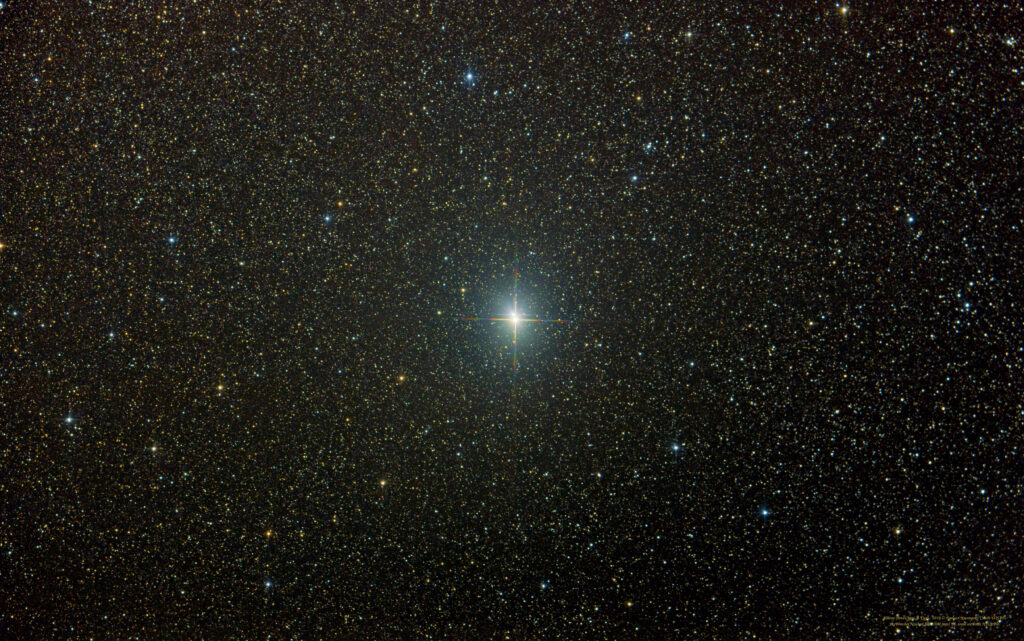
Albireo ( Cygni): Physics of Colors and the Gravity Puzzle
The Swan’s Head Albireo, designated as Beta Cygni ( Cyg), forms the “head” of the Cygnus constellation. Although it appears as a single point to the naked eye (3rd magnitude), even slight magnification—as clearly seen in the attached crop image—resolves it into two components with strikingly different colors. It is one of the most popular targets for summer sky observers.
Thermodynamics: Where Do the Colors Come From? The color contrast in the Albireo system is a textbook example of the relationship between a star’s surface temperature and its color (Wien’s Law).
-
Albireo A (Gold): The brighter component (+3.1 mag) is a bright giant of spectral type K3. Its surface temperature is “only” about 4000 K. It shines with a cool, orange-yellow light.
-
Albireo B (Blue): The fainter component (+5.1 mag) is a hot main-sequence star of type B8. Its temperature exceeds 12,000 K, resulting in blue light emission. Furthermore, it is a Be star, meaning it rotates extremely fast, ejecting matter from its equator.
Astrometry: Physical or Optical System? For years, astronomers considered Albireo a physically bound binary system (stars orbiting a common center of mass). However, recent precise parallax measurements by the Gaia satellite (Data Release 2 and 3) shed new light on this.
-
Different Distances: Measurements indicate that the gold component A lies approx. 328 light-years away, while the blue component B is located at a distance of approx. 389 light-years.
-
Conclusion: They are separated by nearly 60 light-years, suggesting that Albireo is most likely an optical double—stars aligned along the same line of sight but not gravitationally bound. It is a cosmic illusion of perspective.

Observational Parameters The cropped image shows a clear separation of the components. It is approximately 34-35 arcseconds. Such a distance allows the stars to be resolved even with ordinary binoculars, making Albireo an excellent test for optics and color perception.

Source: https://en.wikipedia.org/wiki/Albireo
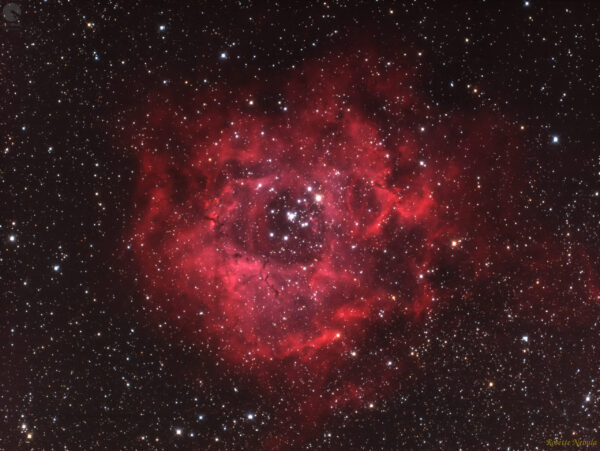
I’ve collected light frames with few different sessions. Photos taken on 2019 at Zwardoń and Bieszczady during PTMA rally.
- Composition: Astro Pixel Processor,
- Processing: GIMP + plug-ins (Linux).