
M81 and M82 – The Perfect Pair
In the constellation Ursa Major lies a pair of objects that serve as the “holy grail” for medium focal lengths. M81 (Bode’s Galaxy) and M82 (Cigar Galaxy) fit within a single field of view, offering an incredible contrast in structure. They are located about 12 million light-years away from Earth but are physically separated from each other by only 150,000 light-years.
This is my first photographic attempt to M81. I’ve collected a lot of photographic material (about 10 hours) but also a lot of it I had to removed due to windy nights and after the first pre-selection I had about 8 hours of photographic material. At the stage of stacking, another 30% had to remove of material remaining based on quality algorithm, which I finally stack together. At the last photo session I noticed that so far, each time I focused the image not well enough.

M81: The Grand Design
M81 is a textbook example of a “Grand Design” spiral galaxy.
-
The Core: The bright yellow center consists of old Population II stars. Deep within lies a supermassive black hole with a mass of 70 million Suns (for comparison: our Sgr A* is only 4 million).
-
The Arms: The blue spiral arms are home to young, hot stars forming within density waves.
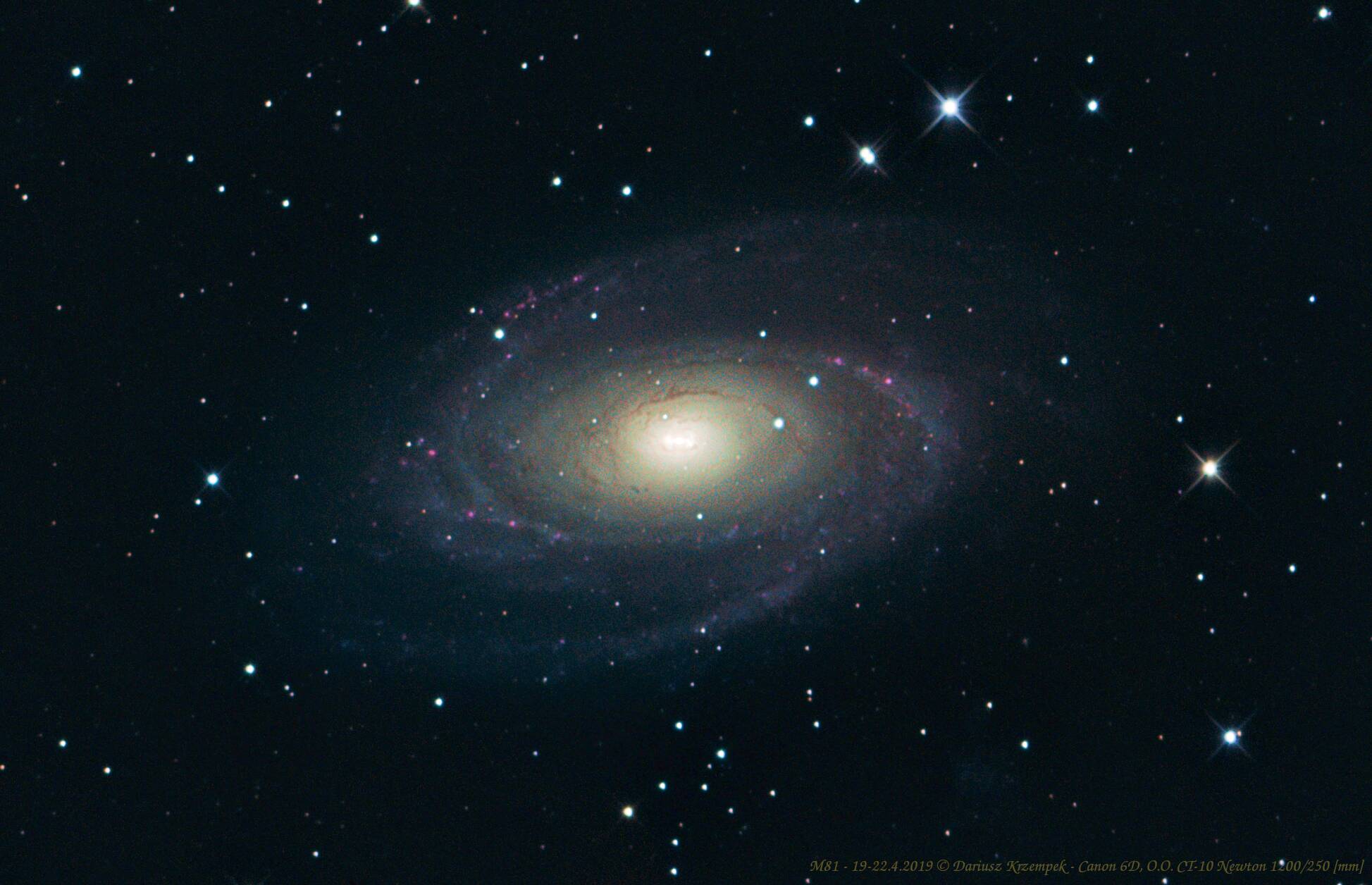
Due to the coma around the frame, where M82 is located, I will have to plan a separate photo session for M82.
M82: Gravity’s Victim (Starburst Galaxy)
M82 looks completely different—like a tattered cigar. This is the direct result of a close encounter with M81 several hundred million years ago.
-
Starburst: Massive tidal forces from M81 “churned” the gas within M82, triggering a violent star formation process (known as a starburst). Stars are born here 10 times faster than in the entire Milky Way.
-
Red Jets: Images reveal “bursts” of red gas perpendicular to the disk. This is ionized hydrogen (H-alpha), driven into space by the stellar winds of thousands of supernovae.

The Advanced Challenge: IFN
The background around these galaxies is not perfectly black. It contains the Integrated Flux Nebula (IFN)—faint dust clouds belonging to our own Milky Way, illuminated not by a single star, but by the collective glow of the entire Galaxy. Bringing them out from the background requires dark skies and long integration times.
Source: https://en.wikipedia.org/wiki/Messier_81 , https://en.wikipedia.org/wiki/Messier_82 , https://en.wikipedia.org/wiki/NGC_3077
- Composition: Astro Pixel Processor (Linux),
- Processing: GIMP + plug-ins (Linux),
- Lights: 5[h] – ISO 1000,
- Flats, Darks, Bias.