
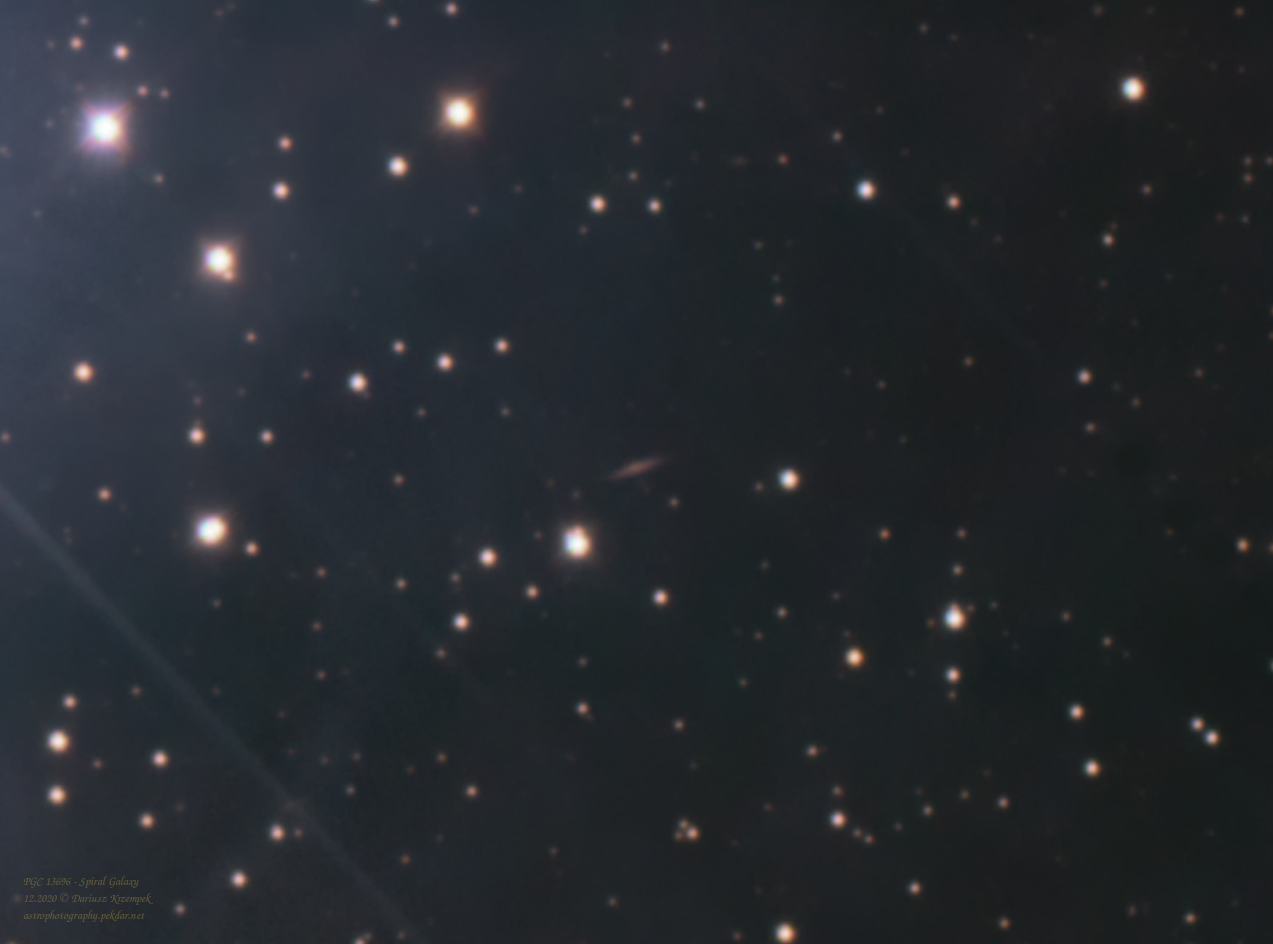
PGC 13696
Beyond Aesthetic Astrophotography When imaging the M45 cluster (The Pleiades), most attention is focused on the bright blue stars and the surrounding reflection nebula. However, for an engineering-minded astrophotographer, the real challenge lies deeper. Just next to the star Electra lies an object that serves as an ultimate test of optical performance and sky transparency – the spiral galaxy PGC 13696, also cataloged as UGC 2838.
Technical Data and Reality
The brightness of this galaxy is approximately 17 magnitude (B). It is an object well beyond the visual reach of most amateur telescopes (even 10-12 inch apertures under average skies).
Type: Spiral Galaxy (Sc)
Distance: ~315-330 million light-years (based on redshift z ~ 0.022)
Apparent Size: approx. 1.0′ x 0.2′
Cosmic Perspective
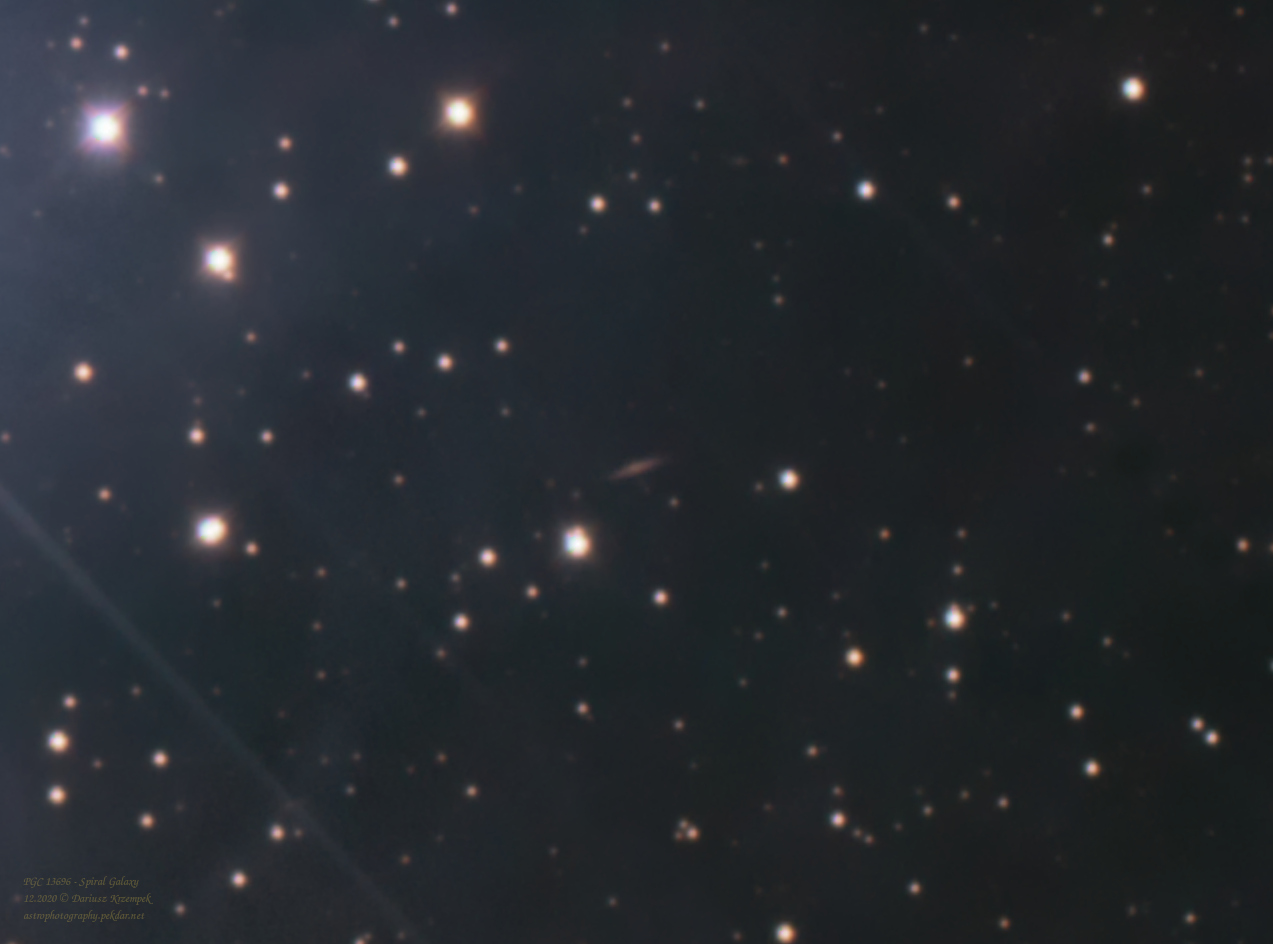
Looking at this image, you are witnessing a drastic contrast of time and space.
Foreground (Electra and dust): The light from the Pleiades stars traveled to us for “only” 440 years. The stars themselves are young, formed about 100 million years ago – back when dinosaurs ruled the Earth (Cretaceous period).
Background (PGC 13696): The light from this faint “fuzz” began its journey towards us over 300 million years ago. This corresponds to the Carboniferous period on Earth – long before the first dinosaurs appeared, when our planet was covered in giant ferns and forests that we mine today as coal.
In the cropped image, the elongated shape of the galactic disk and the faint structure of the spiral arms are clearly visible. Capturing this object so close to a bright star like Electra (3.7 mag) is challenging due to glare and the need to maintain high dynamic range. It requires precise calibration with Flat frames to extract the faint signal from the background sky noise.
Every time I look at such distant objects, I realize what the average life time of a human being is on a cosmic time scale.
A piece of time, how small.

Technical information
Date: 12.2020
Composition: APP
Processing: APP, RawTherapee, GIMP + add-ons (Linux)
Summary exposure: 6h
Calibration frames: Darks, Bias, Flats