Zdobienie

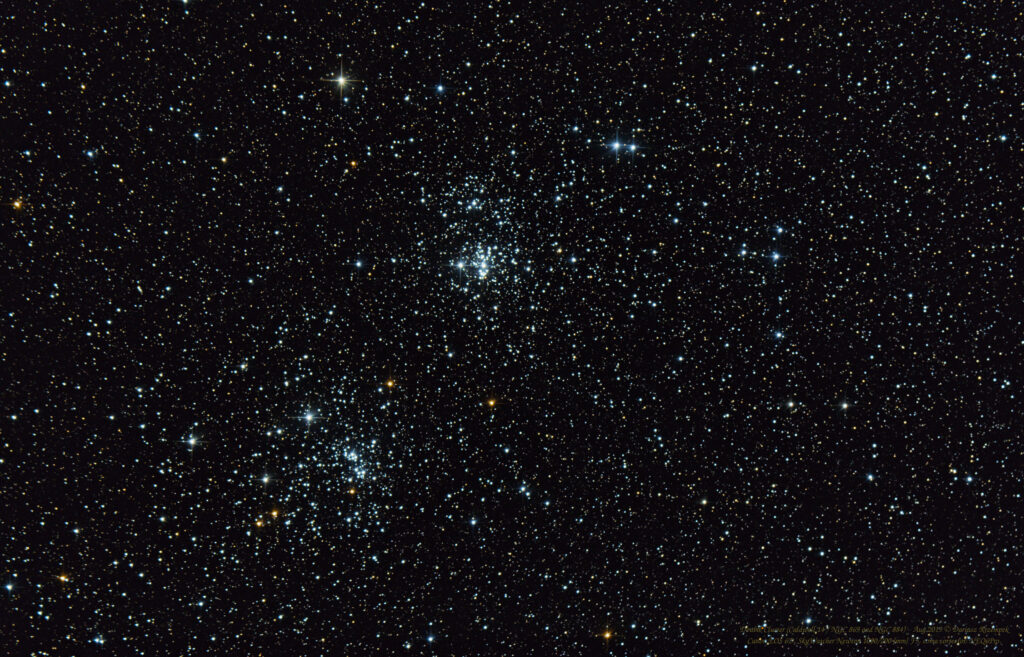
Double Cluster (NGC 869 & 884) – Perseus OB1 Association

Zdobienie

Double Cluster (NGC 869 & 884) – Perseus OB1 Association

Double Cluster Perseus

On the border of Perseus and Cassiopeia sits one of the most spectacular deep‑sky sights — the Double Cluster, also known as h and χ (chi) Persei. To the naked eye it appears as a hazy patch, best seen in autumn/winter between Cassiopeia’s “W” and Perseus. Both clusters lie in the Perseus Arm of our Galaxy.

Double Cluster / Caldwell 14 / Open clusters NGC 869 / NGC 884

Key facts

  • Distance: ~7,500 light‑years (NGC 869 ~7,460 ly; NGC 884 ~7,640 ly).
  • Age: very young, ~12–14 million years (both clusters).
  • Separation: only a few hundred light‑years.
  • Radial velocity: both clusters are blueshifted, approaching at ~38–39 km/s.
  • Stellar content: dominated by hot, young B‑type (B0) stars; notable red supergiants present (e.g., in NGC 884).
  • Association: they form the core of Perseus OB1.

Astrophysics: blue and red

The image is dominated by the cool blue of young, hot spectral type B and A stars. However, distinct orange-red points are clearly visible among them.

  • Evolution: These are Red Supergiants. Despite the cluster’s young age, the most massive stars have already exhausted their hydrogen, expanded, and entered the helium-burning phase. This is a textbook example of how stellar evolution speed depends on mass.

Kinematics

Blueshift Most deep-sky objects are moving away from us (Redshift). The Double Cluster is an exception. Spectroscopic measurements show that this system is approaching Earth with a radial velocity of approximately 20-22 km/s. This means local gravity within the galactic arm dominates over general expansion here.

Curiosities & context

  • In Polish, amateurs sometimes nickname them “hihotki” (wordplay: h + χ). (naming custom)
  • For comparison, the Pleiades (M45) are ~75–150 Myr old — several times older.


Parameter table

Parameter

NGC 869 (h Persei)

NGC 884 (χ Persei)

RA / Dec (J2000)

~02h19m, +57°09′

~02h22m, +57°08′

Distance

~7,460 ly

~7,640 ly

Age

~14 Myr (literature: 12–14 Myr)

~14 Myr (literature: 12–14 Myr)

Total magnitude (V)

~3.7 mag

~3.8 mag

Apparent size

~30′ (pair ~60′ combined)

~30′ (pair ~60′ combined)

Radial velocity

~39 km/s (approaching)

~38 km/s (approaching)

Association

Perseus OB1

Perseus OB1

Cluster separation

Hundreds of light‑years


Source:

Technical photo information:

  • Composition: Astro Pixel Processor,
  • Processing: GIMP v2.10.14 + plug-ins (Linux),
  • Lights: 24 x 96[s], ISO 1250,
  • Flats, Darks, Bias.
Support my work on Ko-fi

Did this guide help you?

I create these guides and projects as a hobby. If I helped you save time or money, consider supporting my work with a coffee. It keeps the energy flowing for future projects.

Categories
Newest articles
Support

Was description useful? Consider to support author, it prevents to post annoying ads for you. All you just could do is once a year, sponsor for me a coffee. The currency, amount, doesn’t matter to me. Matter to me, that you want! :) PayPal link below.

Read

Similar Articles

EQDIRect for NEQ and EQ mounts

EQDIRect for NEQ and EQ mounts

EQDIRect for NEQ and EQ mounts: The GOTO controller is extremely convenient and practical to use, when you want to look at interesting night sky objects, with your own eye through the eyepiece mounted in the telescope’s focuser. The ability to quickly select an object using the GOTO controller, is invaluable.

Read more...
Rosette Nebula - NGC 2237 - Caldwell 49

Rosette Nebula NGC 2237 – Caldwell 49

Rosette Nebula NGC 2237.
In this article, I have gathered in one place the most interesting information about the entire nebula and its selected regions. The information contained in this content is my own compilation based on collected data.

Read more...