
The Laboratory of Gravity and Radiation
The Horsehead Nebula Complex, located within the constellation of Orion, is one of the most important and instructive regions in our Galaxy. Situated at a distance of approximately 1500 light-years from Earth, it serves as the closest active star-forming zone to us, providing a textbook laboratory for interstellar physics.
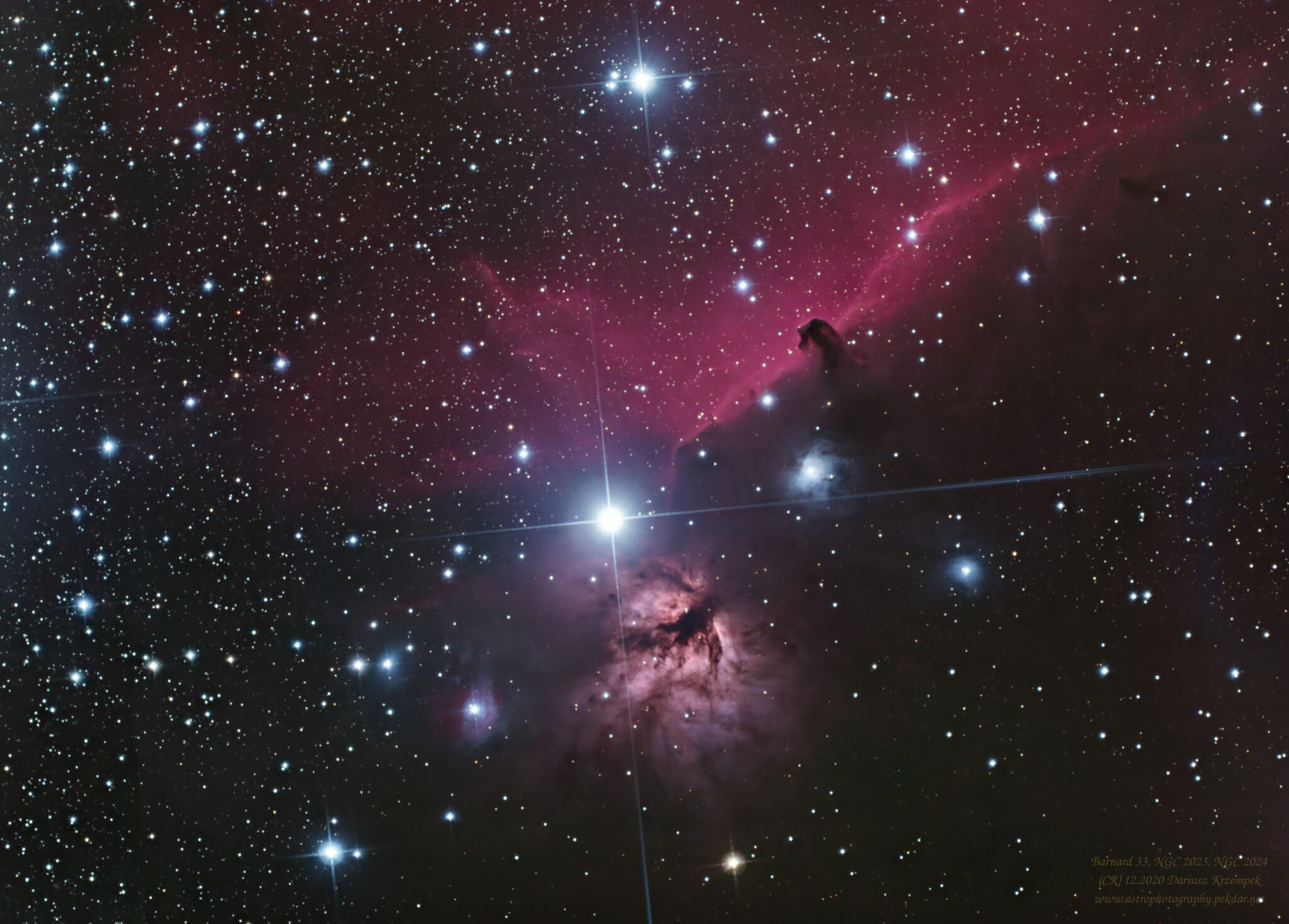
This image focuses on the dynamic interaction of three fundamental types of cosmic matter that coexist within a single frame:
Emission Nebulae (IC 434, NGC 2024), which emit light due to hydrogen ionization.
Dark Nebulae (Barnard 33), which absorb light, forming dense, cold cocoons.
Reflection Nebulae (NGC 2023), which merely reflect and scatter light from a nearby star.
The primary engine and sculptor of this region is ultraviolet (UV) radiation, emitted by massive, short-lived stars such as Alnitak ( Orionis) and Sigma Orionis. Their energy creates powerful stellar winds and generates shockwaves that, over millions of years, erode and compress the parent clouds of gas and dust. Consequently, this image is a visual record of the ongoing cycle of cosmic destruction and creation.
Three Nebula Types in One Frame
The Orion Complex serves as a laboratory showcase, demonstrating how the powerful ultraviolet (UV) radiation from nearby massive stars—such as Sigma Orionis and Alnitak—affects the structure and luminosity of the interstellar medium. In this single frame, we witness textbook examples of three fundamental mechanisms of light-matter interaction.
The Emission Background: IC 434 (Hydrogen Ionization)
The bright, red background dominating the frame is IC 434—a gigantic cloud of hydrogen. This is a classic emission nebula (H II region), which does not reflect light but rather emits its own light through the process of electron recombination.
Mechanism: High-energy UV light, originating from the distant but incredibly powerful star Sigma Orionis, strips electrons from hydrogen atoms. When these electrons “recombine” (drop back to lower energy levels), they emit a photon.
Color/Signature: This process is responsible for the characteristic deep red glow seen in images, dominated by the H-alpha line ().
Crucial Role: IC 434 acts as the “projection screen” for the Horsehead Nebula (Barnard 33). Without this emission background, the dark silhouette of B33 would be invisible.

Barnard 33 (Dust Erosion)
The distinctive black silhouette shaped like a chess piece is Barnard 33. This is a dark nebula—one of the most famous molecular clouds in the Milky Way.
Mechanism: Barnard 33 is not a lack of matter, but an extremely dense, cold molecular cloud of dust and gas that is too thick to let light from IC 434 pass through. The cloud actively absorbs light from behind it, creating the high-contrast silhouette.
Shape and Erosion: The specific “horsehead” shape is the result of photoevaporation. The intense UV radiation from IC 434 (which ionizes hydrogen) simultaneously destroys and evaporates the outer layer of B33.
Future: Barnard 33 is a remnant: its density allows for star formation within its core, but it is being gradually “eaten away” by the radiation of its stellar neighbors.

The Flame Nebula (NGC 2024)
Dominates the right side of the frame. Similar to IC 434, it is an emission region, but its dynamics are more violent due to the proximity of its energy source.
Power Source: It is ionized by the nearby star Alnitak ( Orionis), the easternmost star of Orion’s Belt, though Alnitak itself is not located in the nebula’s core.
Structure: The UV light from Alnitak is so intense that the nebula appears to be “burning” toward the star. The characteristic dark filaments are dense dust positioned in front of the brighter emission gas.
Star Formation: Behind these dark filaments in the Flame Nebula, astronomers have detected numerous protostars—the Flame is one of the most active and closest star-forming regions to us.

The Reflection Nebula (NGC 2023)
The small, blue glow at the base of the Horsehead is NGC 2023. It is one of the brightest examples of a reflection nebula.
Mechanism: Unlike IC 434 (which emits its own light), NGC 2023 merely reflects the light from a star located within its core (HD 37903).
Color/Physics: It glows blue because the process is the same one that gives the Earth’s sky its blue color—Rayleigh Scattering. Short wavelengths (blue) are scattered much more effectively by fine dust grains than long wavelengths (red).
Conclusion: This object completes the complex, demonstrating all three states of matter-radiation interaction: emission, absorption, and reflection.

ASAS 053739-0146.3 (USNOA2 0825-01610019) – Variable star
Spectral type: M9 (Red dwarf, coolest)
Surface temperature in the range: 2,400–3,700 K
IR – Infrared wave source
Mag: 15.35
Stars M class are most common. About 76% of the main sequence stars in the spectral band of the Sun (class G) are class M stars (red dwarfs), their brightness is so low, that it is impossible to see them with the naked eye, except under exceptional conditions.
The brightest known M class main sequence star is M0V Lacaille 8760, with magnitude 6.7 (the limiting magnitude for typical naked-eye visibility under good conditions is typically quoted as 6.5). So, it’s very unlikely that any brighter example of a class M star, will occurs anytime soon. But we can’t this completely ruled out.
As you can see in the example photo, with a telescope with a focal length of 420 [mm], brightness F2.8 and a sensitive RGB camera, by exposing a selected area of the sky long enough, you can register stars of the spectral type M (coolest red dwarfs) with very low brightness (15.35 mag) with a very clear presence in the entire frame.
It’s worth noting that red dwarfs burn out very slowly, which means they can be very, very old compared to other types of stars.

Technical information
- Date: 12.2020
- Composition: APP
- Processing: APP, RawTherapee, GIMP + add-ons (Linux),
- Lights: 170 x 60[s] (2h 50min.),
- Calibration frames: Flats, Bias, Darks.
Own study based on sources:
– https://en.wikipedia.org/wiki/Stellar_classification
– https://en.wikipedia.org/wiki/Stellar_classification#Class_M
– https://en.wikipedia.org/wiki/Flame_Nebula