
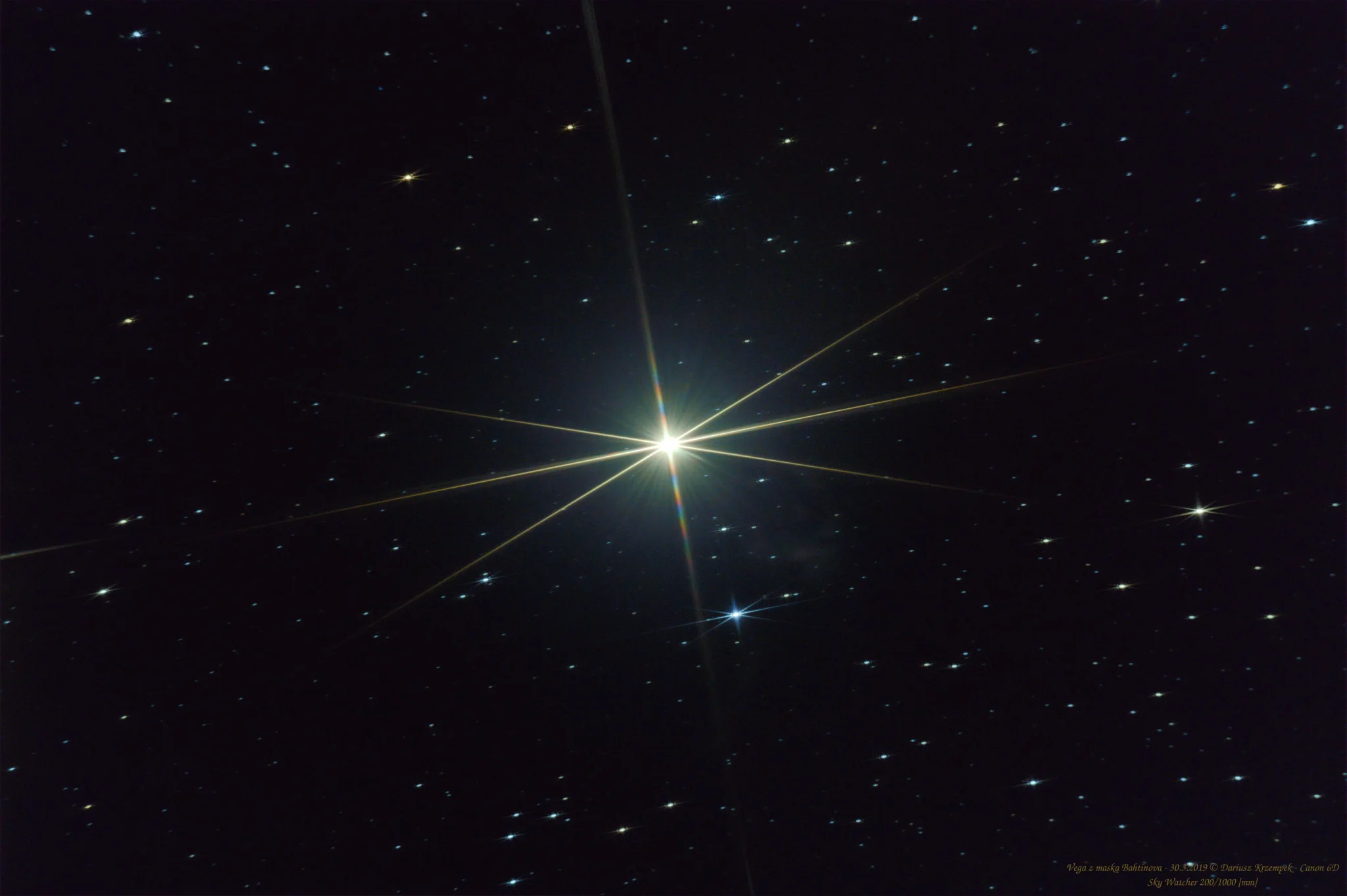
Bahtinov Mask
Focusing in astrophotography is a binary process: it’s either perfect, or the image is ruined. Even a tiny shift in the focuser will turn stars into unappealing blobs. Vega, with an apparent magnitude close to , is the ideal “testing ground” for a Bahtinov mask.
How Does the Bahtinov Mask Work?
The mask is a precisely cut overlay for your telescope or lens. It utilizes the phenomenon of light wave diffraction at the edges of the slits. Due to the specific arrangement of slots at three different angles, the mask generates three pairs of “spikes” (rays) emerging from the point of light.
Interpreting the Pattern: Seeking Symmetry
When you look at Vega through the mask in Live View (at maximum magnification), you will see a characteristic “X” shape with an additional line passing through the center.
-
Out of Focus: The middle line is shifted up or down relative to the intersection of the “X” arms.
-
Perfect Focus: The middle line intersects exactly at the central point of the “X,” creating a perfectly symmetrical “snowflake” pattern.
Why Vega?
Vega is one of the brightest stars in the northern sky. Its intense glow ensures that the diffraction spikes are long, sharp, and easy to evaluate, even on a camera screen. This allows for shorter exposure times during focusing, speeding up your entire session setup.
Technical Pro-Tip:
Once focus is achieved, remove the mask! Forgetting this is a classic rookie mistake that results in ruining the entire session with “cut” stars.
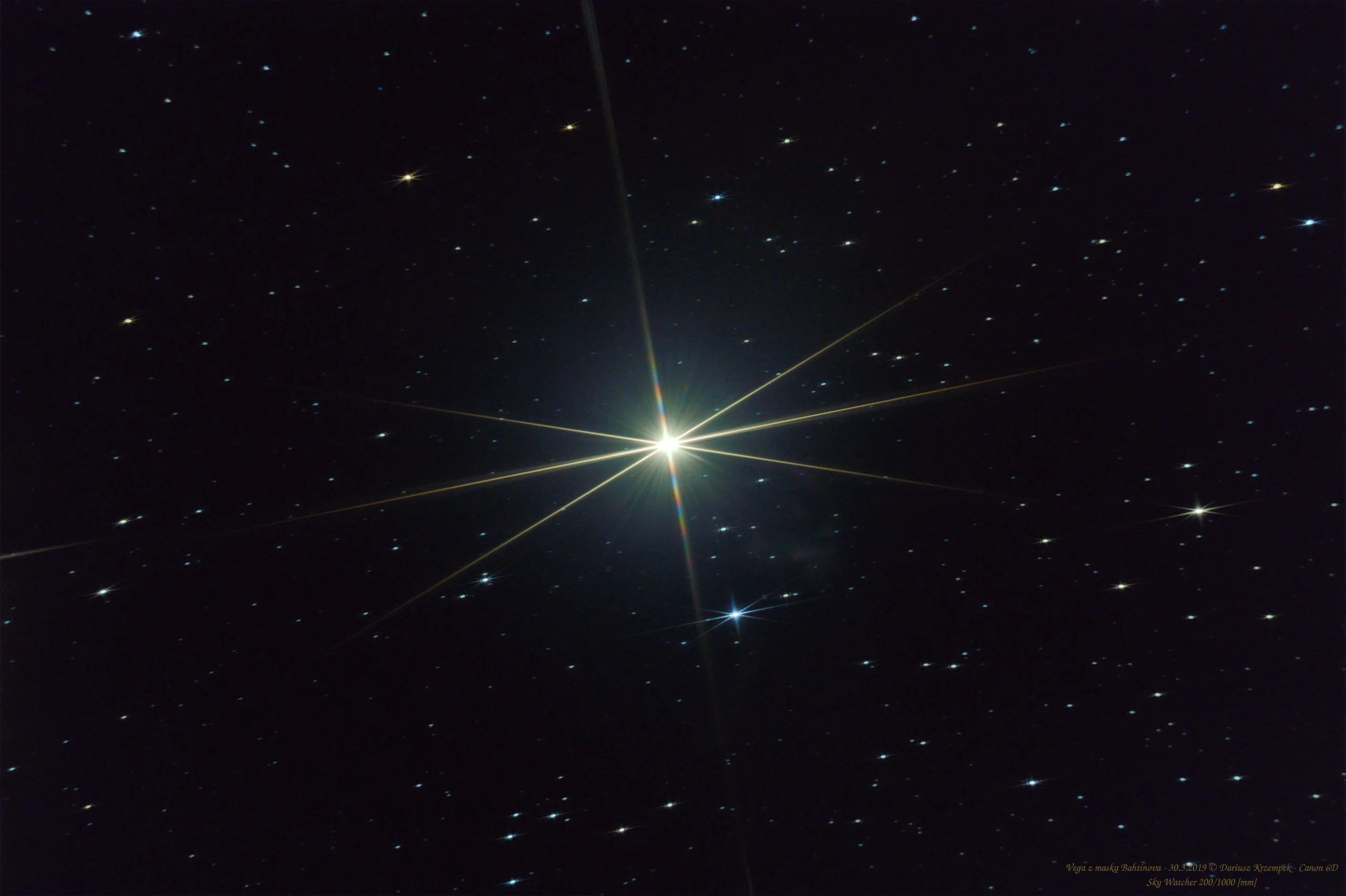
Basic Facts about Vega (Alpha Lyrae)
-
Constellation: Lyra
-
Brightness: one of the brightest stars in the night sky (second brightest in the northern hemisphere after Arcturus)
-
Distance: approximately 25 light-years from Earth
-
Spectral Type/Color: A0V; a massive, young, blue-white main-sequence star
-
Age: about 455 million years; significantly younger than the Sun
-
Special Features: hosts a circumstellar dust disk suggesting a forming or existing planetary system; also a rapid rotator
The Significance of Vega
Vega has enormous astronomical significance, primarily because of Earth’s axial precession.
-
Pole Star: The current Pole Star is Polaris. However, about 14,000 years ago Vega lay near the north celestial pole and served as the Pole Star. Due to precession, in roughly 12,000 years (around 14,000 AD), Vega will once again occupy this honored position.
Why Vega Is Ideal for Focusing
Vega, as a bright blue-white star, is ideal for focusing with a Bahtinov mask for two main reasons:
- Extreme Brightness: The Bahtinov mask relies on light diffraction. The more light that reaches the sensor in a short time, the faster and clearer the characteristic diffraction pattern appears. As a very bright star, Vega minimizes the need for long exposures, enabling almost instantaneous focus verification.
- Spectral Type (Blue-White / Low Color Index): Stars with zero or negative color index are extremely hot and emit light at shorter wavelengths, close to white or blue. This matters because:
-
-
It helps minimize the impact of chromatic aberration (the splitting of light into different colors by lens elements).
-
The diffraction pattern is higher in contrast and more consistent across the visual band, allowing more precise and unambiguous determination of perfect focus.
-
Indicating Ideal Focus
The key to using the mask is observing the position of the central diffraction spike relative to the outer spikes:
-
Out of focus: the central spike is shifted—positioned to one side of where the outer spikes intersect.
-
Perfect focus: by adjusting the focuser, aim for the moment when the central spike aligns exactly and crosses at the midpoint of the outer spikes, creating a perfectly symmetrical, three-armed pattern (resembling a “snowflake”).
My own experience using various Bahtinov and TriBahtinov masks indicates that the mask’s craftsmanship also has a direct impact on focus adjustment. A poorly made mask can adversely affect the focusing process. I have learned how to correct these “minor” mask errors… My “method/procedure” will be described and made available on this page in a dedicated article.
Photos: March 2019
-
Astro Pixel Processor (APP): Used for calibration (applying darks, biases, flats) and stacking the 6 best frames.
-
Processing: GIMP v2.10.14 + plugins (Linux), basic post-processing tasks – levels/curves adjustment, noise reduction, and sharpening (unsharp mask).
-
Lights: 6 × 57 s at ISO 1600; 30 March 2019
-
Flats: 21 at ISO 1600; 02 August 2019
-
Biases: 20 at ISO 1600; 02 August 2019
-
Darks: 80 at ISO 1600; 30 March 2019