
Stars over Teide – Tenerife 2019
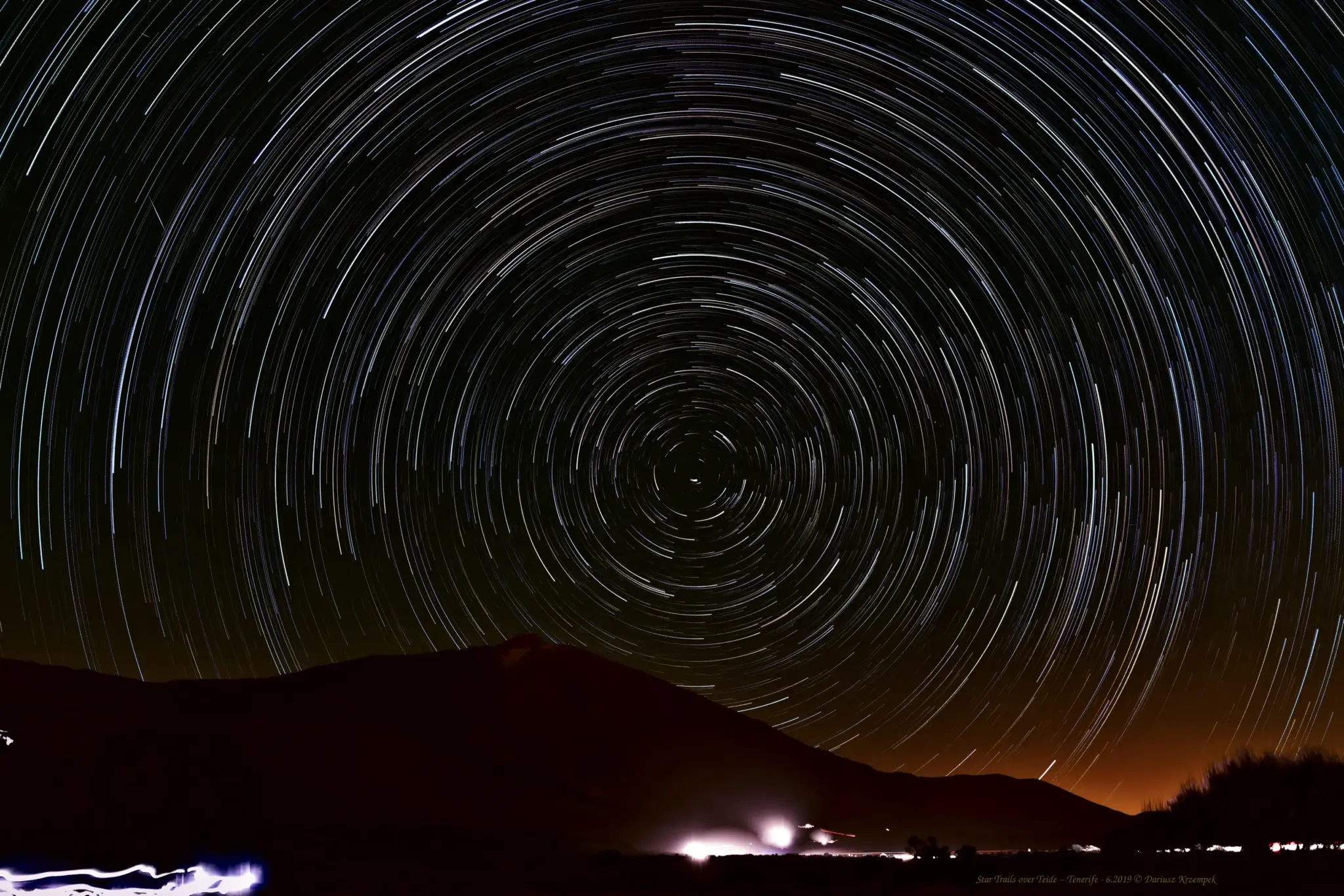
This short night-sky time-lapse over Teide was created during the PTMA expedition to Tenerife in 2019. Composed of 140 frames, the sequence demonstrates the smooth motion of stars relative to Earth’s rotation over the volcanic landscape of Las Cañadas.
Why Teide Offers an Advantage Teide is Spain’s highest peak (approx. 3715–3718 m a.s.l.) and the heart of Parque Nacional del Teide, a UNESCO World Heritage site since 2007 – one of the most valuable volcanic landscapes in the world.
Observational conditions are shaped by the “Mar de Nubes” – a trade-wind inversion layer. Cool, moist air and clouds below “cut off” coastal light pollution, while above (over 2000 m a.s.l.), the air remains dry and stable. This results in a darker background and superior image stability (seeing).
The sky quality is also legally protected since 1988 by the “Ley del Cielo” (regulating outdoor lighting, radio emissions, and flight paths), which tangibly supports the observatories’ work. Nearby, at Izaña (approx. 2390 m), operates the Teide Observatory – a key European center for solar research and photometry. While the Atacama in Chile holds the global record for atmospheric dryness, Teide remains the reference site for astronomy in Europe.
Shot Parameters (Time-lapse)
-
Frames: 140 (compiled into 3 sequences; two played faster to visualize dynamics).
-
Location: Vicinity of the Las Cañadas caldera (Tenerife), approx. 2200 m a.s.l.
-
Phenomenon: Visible apparent motion of the celestial sphere due to Earth’s rotation.
Visual Analysis The footage is dominated by the concentric arcs of star motion over a raw, volcanic foreground. Near the low horizon, a slight glow from the cloud layer (“sea of clouds”) is visible – acting as a natural “filter” suppressing light pollution from the tourist towns below.
Sources / Further Reading