
Moon first quarter
Why Not the Full Moon? Beginner observers often wait for the Full Moon, thinking it’s the best time for photography. In reality, a Full Moon appears “flat” because sunlight falls perpendicular to the surface, eliminating shadows. The First Quarter is a magical moment—the Sun illuminates the Moon from the side, bringing out monumental mountains and deep craters along the terminator line.
The Terminator: The Boundary of Light and Dark
The terminator is the line separating the illuminated part of the Moon from the part shrouded in night. This is where the action happens. Due to the low angle of sunlight, even small elevations cast long shadows, allowing us to perceive the three-dimensionality of the terrain.
What to Photograph During the First Quarter?
During this phase, some of the most spectacular formations appear along the light line:
-
The Crater Triad (Theophilus, Cyrillus, Catharina): An impressive group of three large craters with varying degrees of erosion. Theophilus has prominent central peaks that cast sharp, long shadows across the crater floor during the first quarter.
-
Albategnius Crater: A large, ancient crater with a distinct central peak that is among the first to emerge from the darkness.
-
Mare Serenitatis (Sea of Serenity): Along its shores, systems of ridges and faults are visible, appearing like ripples on a water surface under side-lighting.
Technical Tip: Exposure Time
During the first quarter, the dynamic range of brightness is immense. Bright highlands are very high-contrast compared to the dark “maria.” During your session, try not to overexpose (blow out) the bright edges of the craters—it’s better to slightly underexpose and recover shadow details during post-processing (e.g., during the stacking process in AutoStakkert!).
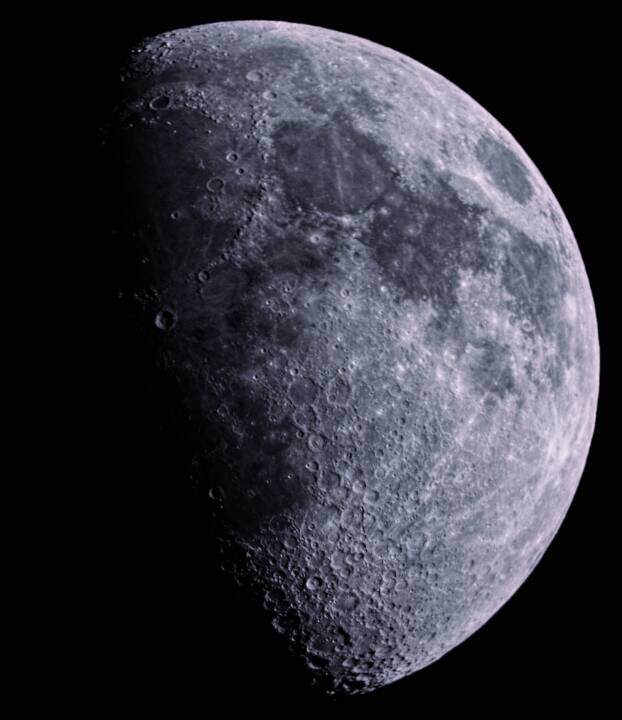
My first photo of the Moon. It took me a long time to finally snap a picture of it—I just couldn’t bring myself to dive into the topic. Once I had gathered the photo and video material, I procrastinated again when it came to processing it. Maybe it’s because photographing the Sun, Moon, or planets is a completely new subject for me. Eventually, I sat down and the fun began. While wrestling with AutoStakkert and editing the images, some side projects emerged—let’s call them… oh never mind. When they’re ready, you’ll find out right here on this page.
Light Frames:
- 114 x ISO 12.800, 0,00025[s],
- RAW files of .CR2 with conversion to .TIFF (16-bit) file type, 5488×3662 [px].
Processing:
- AutoStakkert v. 2.6.8
- RawTherapee v.5.8
- Gimp v. 2.10.14