
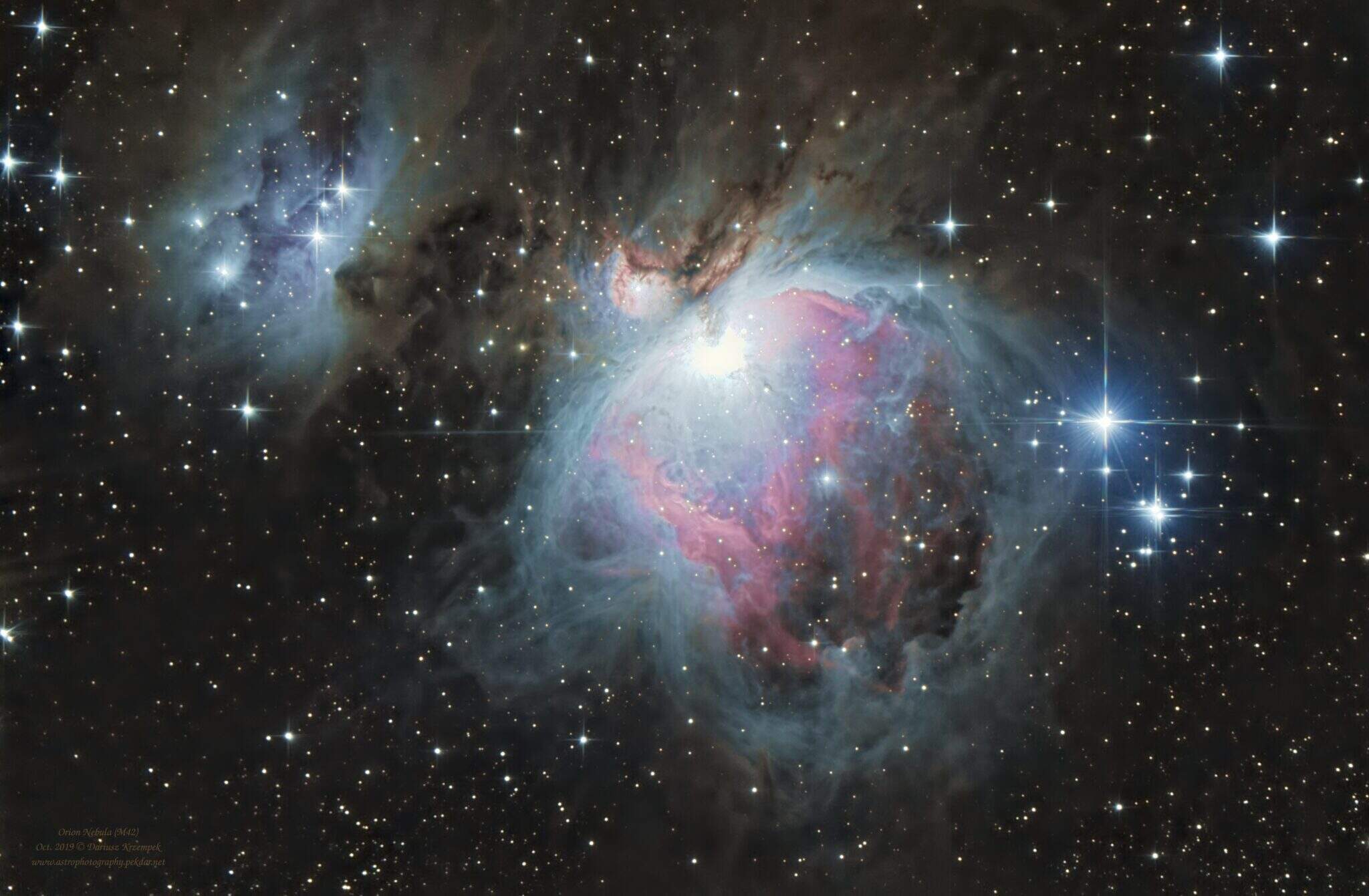
M42 Orion Nebula
The Nearest Nursery M42, the Great Orion Nebula, is the undisputed queen of the winter sky. Located just 1344 light-years away, it is the closest region of massive star formation to Earth. Due to its proximity and brightness (visible to the naked eye), it allows for a detailed analysis of matter creation and destruction processes that remain invisible to us in other galaxies.
This article presents two different approaches to the same object, revealing its complex nature: the surrounding dark dust and the energetic heart.
The Dust Cloak (Outer Structures)
Looking at the deeper parts of the image, we see that M42 is not suspended in a void. It is part of the gigantic Orion Molecular Cloud (OMC-1).
-
Dark Nebulae: The gray, “dirty” structures surrounding the bright center are dense interstellar dust. This is the building material that has not yet been ionized by the stars.
-
Context: Here, we witness the dynamic battle between light and matter. Radiation from the center “pushes” and sculpts these clouds, creating shockwaves within the medium.

The Nebula Engine and H-alpha
The second image and next reveals completely different physics – ionization and the core.
-
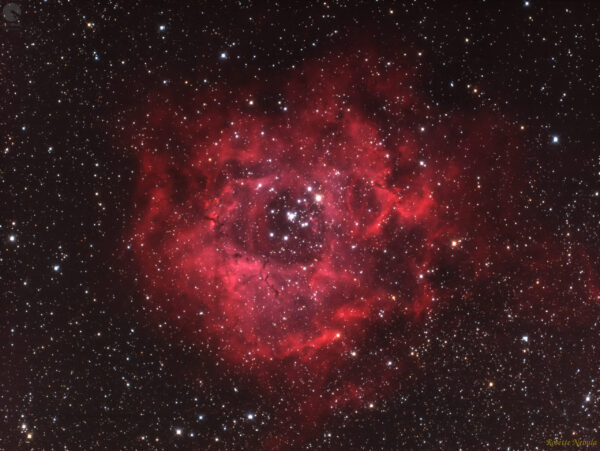
Red Color: The dominant red is the signature of hydrogen (H-alpha line). It indicates high energy in this region.
-
The Trapezium Cluster (Theta-1 Orionis): At the very center, often overexposed in amateur images, lies a cluster of young, massive stars – the Trapezium. These four main stars (A, B, C, D) are the “engine” of the entire nebula. Their powerful UV radiation illuminates the gas over hundreds of light-years and has excavated the visible “cavity” in the center of the cloud seen in the image.


Technical Challenge
Dynamic Range (HDR) M42 is one of the most difficult objects to expose correctly due to its extreme dynamic range. The brightness difference between the core (Trapezium) and the outer dust loops is so vast that a camera sensor cannot capture both in a single exposure. To show the nebula’s center (rather than a blown-out white patch) alongside faint outer veils, it is necessary to use HDR (High Dynamic Range) techniques or layer masking, blending short exposures (for the core) with long ones (for the background).
Source: https://en.wikipedia.org/wiki/Orion_Nebula
First photo taken on October 2019.
- Composition: APP (13 frames)
- Processing: RawTherapee and GIMP v2.10.18 + add-ons (Linux)
- Lights: 13 x 600[s], ISO-400;
- Bias, Flats
Second and next photos:
- Composition: Astro Pixel Processor v1.078,
- Processing: GIMP v2.10.14 + plug-ins and RawTherapee 5.6,
- Lights: 21 x 60[s] ISO 1600,
- Flats: 20, ISO-1600,
- Darks: 9, ISO-1600,
- Bias: 20, ISO-1600