
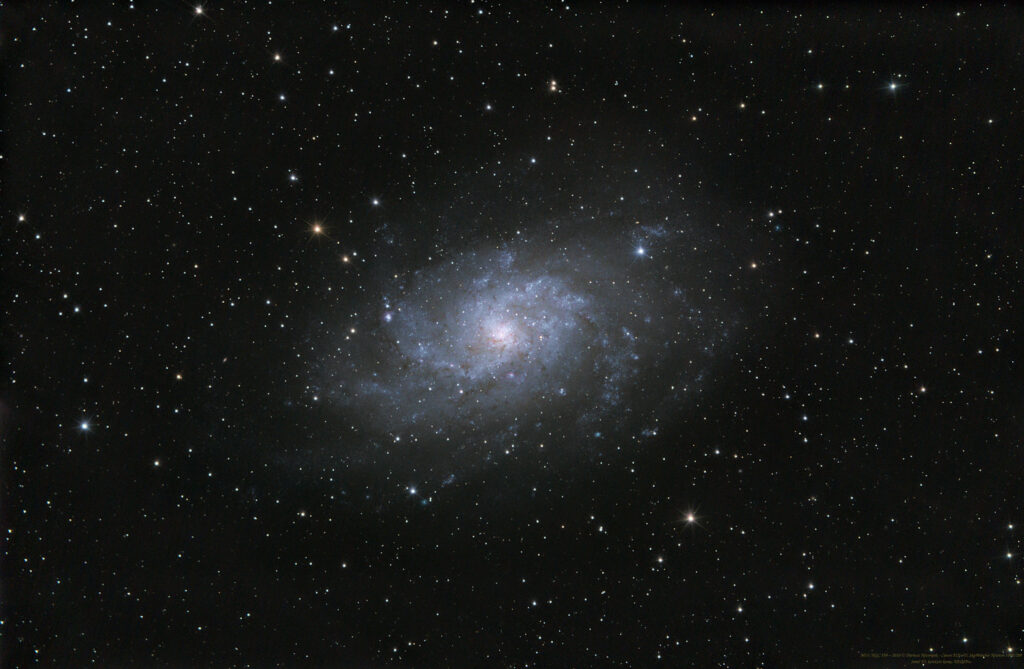
M33 Triangulum Galaxy
The Third Player M33, known as the Triangulum Galaxy, is the third-largest member of our Local Group (after M31 and the Milky Way), located approximately 2.8 million light-years away. Although catalogs list it as a bright object (+5.7 mag), for an astrophotographer, it is a classic trap. M33 is positioned almost perfectly “face-on” relative to Earth. Its light is spread over a massive area of the sky (approx. 70 x 40 arcminutes – more than two Full Moons!).
-
Engineering Conclusion: This results in extremely low surface brightness (approx. 23 mag/arcsec²). This means the signal from the spiral arms is only marginally stronger than the background noise (Sky Glow). Capturing the disk’s periphery requires perfect calibration (Flat frames) and dark skies.

Object Anatomy
SA(s)cd Galaxy Unlike Andromeda (M31), M33 is classified as SA(s)cd. What does this code mean?
-
No Bar (SA): A pure spiral.
-
Loosely Wound Arms (cd): The arms are not tightly wrapped, allowing for easy separation of individual star clouds.
-
No Central Bulge: This is a key feature. M33 likely lacks a supermassive black hole at its center (or it is very small), making it a unique subject for studying the evolution of “pure” galactic disks.
NGC 604
The Monster in the Arm Looking at the image, in one of the spiral arms (usually in the upper-left section, depending on orientation), a distinct red patch is visible. This is not a sensor artifact. This is NGC 604.
-
Scale: It is a gigantic H II region with a diameter of nearly 1500 light-years.
-
Comparison: If NGC 604 were located where our Orion Nebula (M42) is, it would be so bright that it would cast shadows on Earth at night.
-
Physics: It is a nursery where over 200 massive O and B-type stars ignited in a single astronomical moment (approx. 3 million years ago). Their stellar wind is so powerful that it blows “bubbles” in the galaxy’s structure, visible in H-alpha band images.

Technical Imaging Aspect
To highlight the structure of NGC 604 and other smaller H II regions scattered across the arms (red “knots”), it is highly recommended to blend H-alpha narrowband signal into the RGB data. This acts as a contrast booster for ionized hydrogen, allowing these regions to cut through the blue glare of young star clusters.
Two different locations, more than 200 km apart. Two different telescopes, different size, focal length,
light. Two different tools for collecting photons with completely different parameters.
Until now, my computer didn’t really have much to count, but everything changed when I get idea to try, to stack two totally
different data sets together. I like such challenges. I’ve spent a lot of time on it with processing stack. The average of time consumed with one single stack processing, took me around 6 hours. It was test stacks + experiments…. I’ve lost in time how many there were, hours or maybe days spent only for the processing of the data itself. Anyway, the power meter count what it wanted and I will pay for this later.
An interesting fact for me was, that the result stack reached a resolution of 23k x 23k [px], and its size was of 6.3 GB. Displaying such an image greedy consumed ¾ from the available memory of my computer. Processing such a photo was a bit tiring, after cropping it was better, but the final .png file with photo, was just over 300MB in the resolution of 9085 x 6950 [px].
Well…. I must admit that I had a lot of fun with it and a lot of side text was written during processing of stack. Something will come of it.
Source:
https://en.wikipedia.org/wiki/Triangulum_Galaxy
Location
1: I’ve collected light frames with few different sessions. Photos taken on 2019 at Zwardoń and Bieszczady during PTMA rally.
Composition: Astro Pixel Processor,
Processing: GIMP + plug-ins (Linux).
Location 2: Photos collected at 9.2020 near Bielsko-Biała.
- Stack processing: APP
- Photo processing: Raw Therapee +
GIMP + plugins (Linux) - Lights: 340 x 40[s]
- Darks, Bias, Flats, DarkFlats