
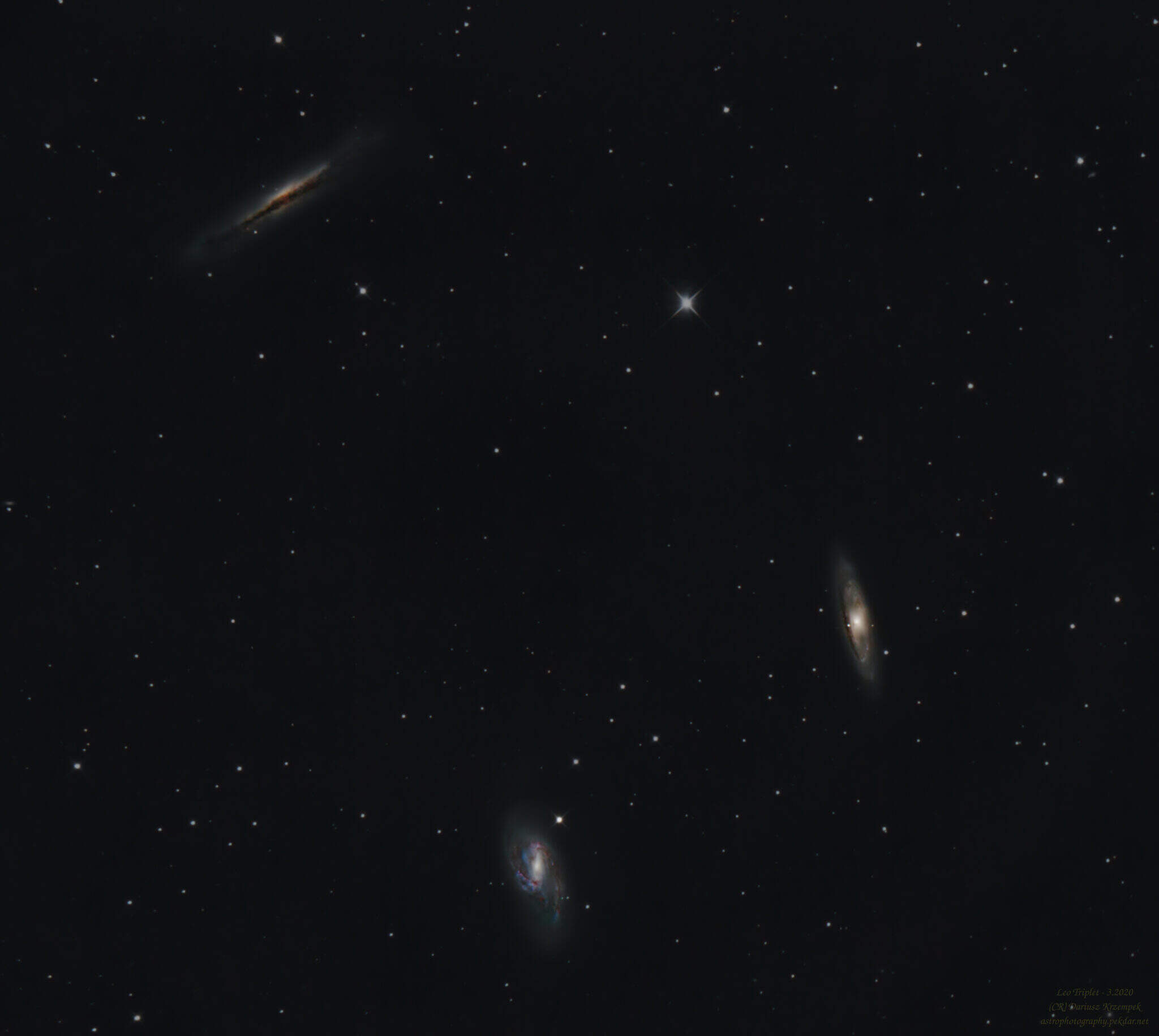
The Leo Triplet – A Cosmic Laboratory
Is more than just a popular astrophotography target in the spring sky. It is a textbook example of tidal interactions between galaxies. Located approximately 35 million light-years from Earth, the group consists of three large spiral galaxies: M65, M66, and NGC 3628, all fitting within a single field of view, creating a spectacular frame.

Source: https://en.wikipedia.org/wiki/Leo_Triplet
Detailed Object Analysis
M65 (NGC 3623): In contrast to its neighbor, M65 appears “calm.” It is a tightly wound spiral that, despite the proximity of other objects, has maintained a relatively intact disk structure, although a trained eye might spot a slight warp at the edges.
M65 – is an intermediate spiral galaxy about 35 million light-years away in the constellation Leo, within its highly equatorial southern half. It was discovered by Charles Messier in 1780. With M66 and NGC 3628, it forms the Leo Triplet, a small close group of galaxies. The galaxy is low in dust and gas, and there is little star formation in it, although there has been some relatively recently in the arms. The ratio of old stars to new stars is correspondingly quite high. In most wavelengths it is quite uninteresting, though there is a radio source visible in the NVSS, offset from the core by about two arc-minutes. The identity of the source is uncertain, as it has not been identified visually, or formally studied in any published papers.

To the eye, M65’s disk appears slightly warped, and its relatively recent burst of star formation is also suggestive of some external disturbance. Rots (1978) suggests that the two other galaxies in the Leo Triplet interacted with each other about 800 million years ago. Recent research by Zhiyu Duan suggests that M65 may also have interacted, though much less strongly. He also notes that M65 may have a central bar—it is difficult to tell because the galaxy is seen from an oblique angle—a feature which is suggestive of tidal disruption.
Source: https://en.wikipedia.org/wiki/Messier_65
M66 (NGC 3627): The largest and brightest of the group (9.0 mag). The image reveals a clear asymmetry in its spiral arms. This is a direct result of gravitational “tugging” by its neighbor, NGC 3628. The core is offset, and the dust structure is disturbed – evidence of a turbulent dynamic past.

Huge amounts of dust and numerous bright star clusters are found along the galaxy’s vast spiral arms.
Four supernovae have been observed in this galaxy so far: SN 1973R, SN 1989B, SN 1997bs.
Source: https://en.wikipedia.org/wiki/Messier_66
NGC 3628 (The Hamburger Galaxy): Seen perfectly edge-on. Its most characteristic feature is the massive dust lane cutting across its equator. This galaxy has suffered the most from the gravitational encounter – its disk is visibly puffed up and distorted at the extremities. The NGC 3628 – also known as the Hamburger Galaxy or Sarah’s Galaxy, is an unbarred spiral galaxy about 35 million light-years away in the constellation Leo. It has an approximately 300,000 light-years long tidal tail. Along with M65 and M66, NGC 3628 forms the Leo Triplet, a small group of galaxies. Its most conspicuous feature is the broad and obscuring band of dust located along the outer edge of its spiral arms, effectively transecting the galaxy to the view from Earth.

Due to the presence of an x-shaped bulge, visible in multiple wavelengths, it has been argued that NGC 3628 is instead a barred spiral galaxy with the bar seen end-on. Simulations have shown that bars often form in disk galaxies during interactions and mergers, and NGC 3628 is known to be interacting with its two large neighbors.
Source: https://en.wikipedia.org/wiki/NGC_3628
Engineering Challenge
The Tidal Tail The main challenge in processing this data is not just showing the galaxies, but preserving detail in the dark dust lane of NGC 3628 while avoiding overexposure of the M65 and M66 cores. Deep exposure (long integration time) allows, under favorable conditions, the capture of the faint “tidal tail” extending from NGC 3628 – a stream of stars ripped from the galaxy by the gravity of M66 approximately 800 million years ago.
Technical Summary
The image demonstrates the morphological diversity of spiral galaxies depending on their inclination angle relative to the observer: from “face-on” (M66), through an intermediate angle (M65), to “edge-on” (NGC 3628).
Lights taken at 14/15-3.2020 near Bielsko-Biała city.
Composition: Astro Pixel Processor v1.8,
Processing: GIMP v2.10.30 + plug-ins (Linux),
Lights: 44 x 180[s] ISO-800,
Darks: 15 ISO-800,
Bias: 20 ISO-800