
A Ghost in the Radio Telescope
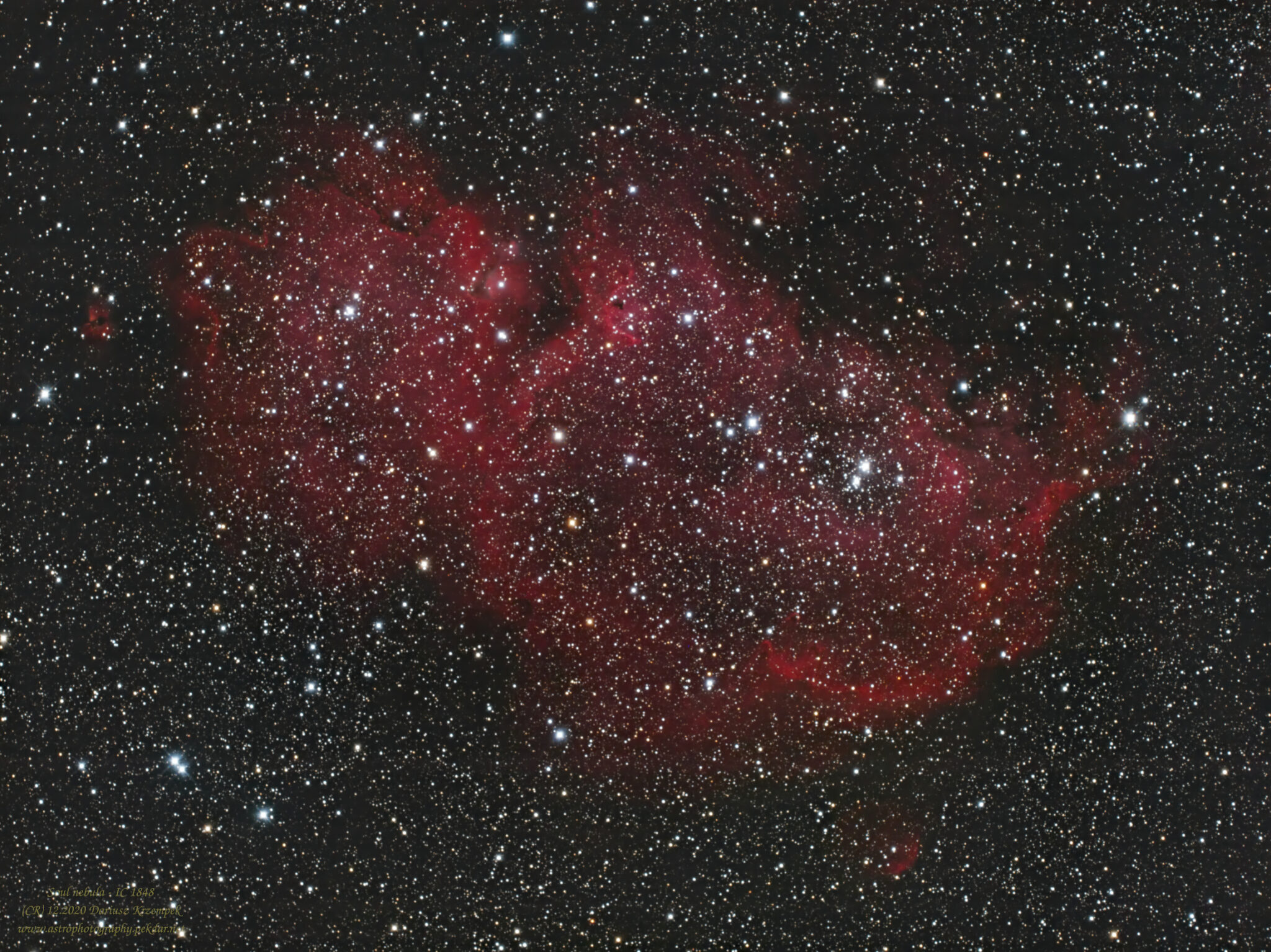
To the modern astrophotographer, this object is known as the “Soul Nebula” due to its shape accompanying the nearby “Heart”. However, to science, it is primarily Westerhout 5 (W5). It was first cataloged in the 1950s by Dutch astronomer Gart Westerhout, not with an optical telescope, but with a radio telescope. W5 is a strong source of radio emission, indicating the presence of vast amounts of ionized gas, invisible to the human eye but perfectly captured by modern sensors in the Hydrogen-alpha band.
IC 1848 Soul Nebula is a vast, beautiful emission nebula located in the constellation Cassiopeia. It is often paired with its neighbor, the Heart Nebula (IC 1805), forming the famous “Heart and Soul” complex. Stretching over 100 light-years, the Soul Nebula’s distinctive glowing structures are sculpted by the intense radiation from young, hot stars that have formed within it. Due to its striking appearance, IC 1848 is a popular and rewarding target for astrophotography, particularly when using narrowband filters (e.g., , , and ).
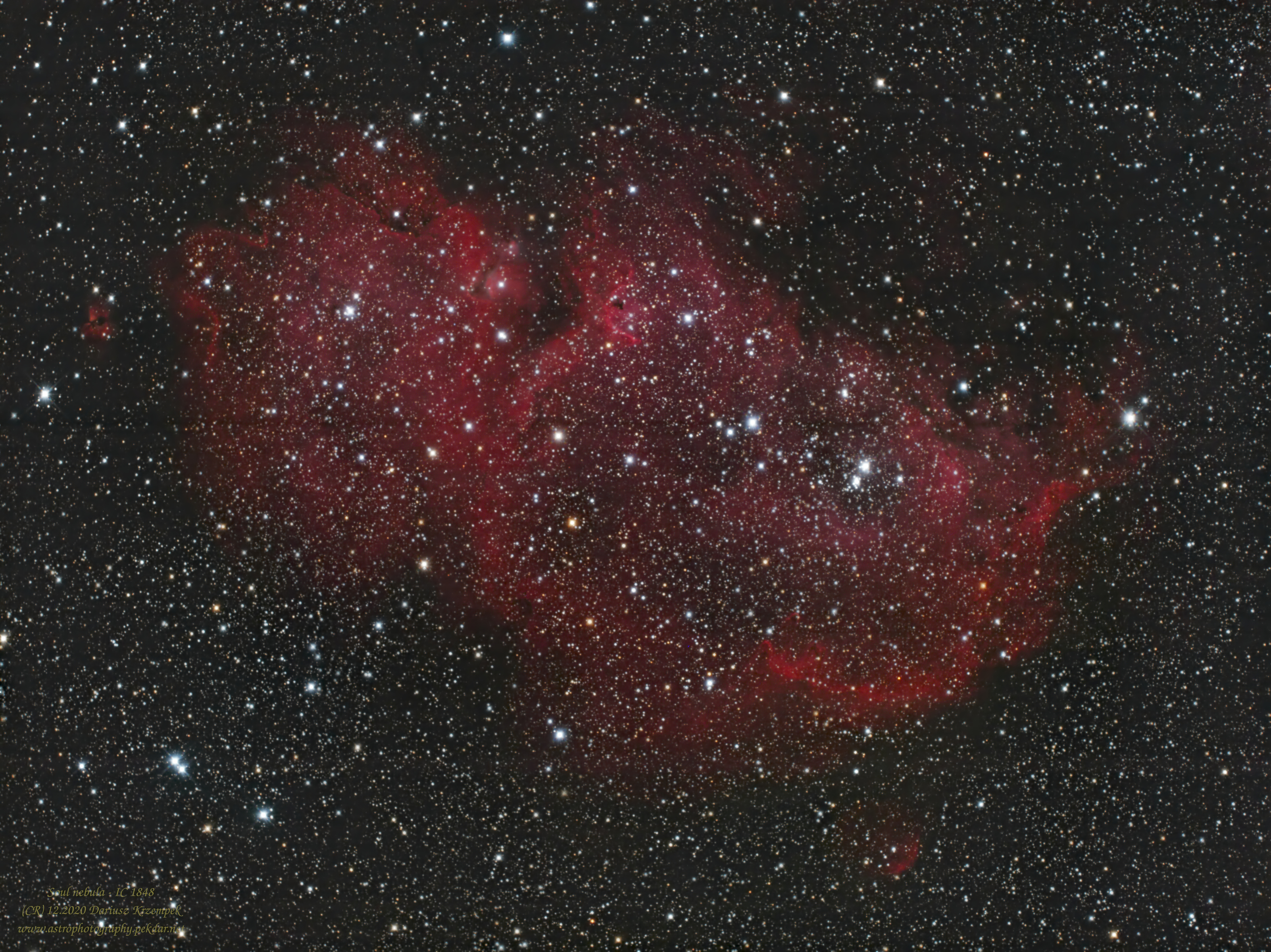
IC 1848 – Sould Nebula – reduced stars brightness
6000 light years away from Earth and is located in the Perseus Arm of the Galaxy in the constellation Cassiopeia. It is an emission nebula showing glowing ionized hydrogen gas.
IC 1848 (also OCL 364) is also used to describe the open cluster associated with the Soul Nebula, that highlights the nebula. Its brightness is 6.5 magnitude.
The Soul Nebula is related to the Heart Nebula (IC 1805). Both mentioned nebulae, cover an area of approximately 300 light-years. They both emit bright red light from hydrogen emmision.
Structure: Cosmic Bubbles
Looking at the image, you are not seeing a flat patch, but three-dimensional cavities. This nebula consists of giant bubbles carved out of the interstellar medium.
-
The Center: Massive stars of the IC 1848 cluster reside here.
-
The Mechanism: Their stellar winds and radiation “clear” the space around them, pushing material outward.
-
The Edges: It is there, at the boundaries of these bubbles (visible as brighter, high-contrast rims in the image), that the gas is compressed.
Triggered Star Formation This image documents a process of “generational relay”. The pressure exerted by massive stars from the center compresses the gas at the nebula’s periphery. Within these compressions, gravitational collapse occurs, leading to the birth of new stars. Particularly in the eastern part of the nebula (often called the “Head” or “Embryo”), astronomers have identified numerous EGGs (Evaporating Gaseous Globules) – dense gas cocoons where protostars are still forming, shielded from the destructive UV of their older neighbors.
Photographic Challenge
IC 1848 is an object of lower surface brightness than the neighboring Heart Nebula. It requires longer integration time to bring out the subtle dust structures inside the “bubbles”, not just the bright rims. A key step here is separating the nebular signal from the dense star field of the Milky Way in Cassiopeia (star reduction) to emphasize the gas structure.
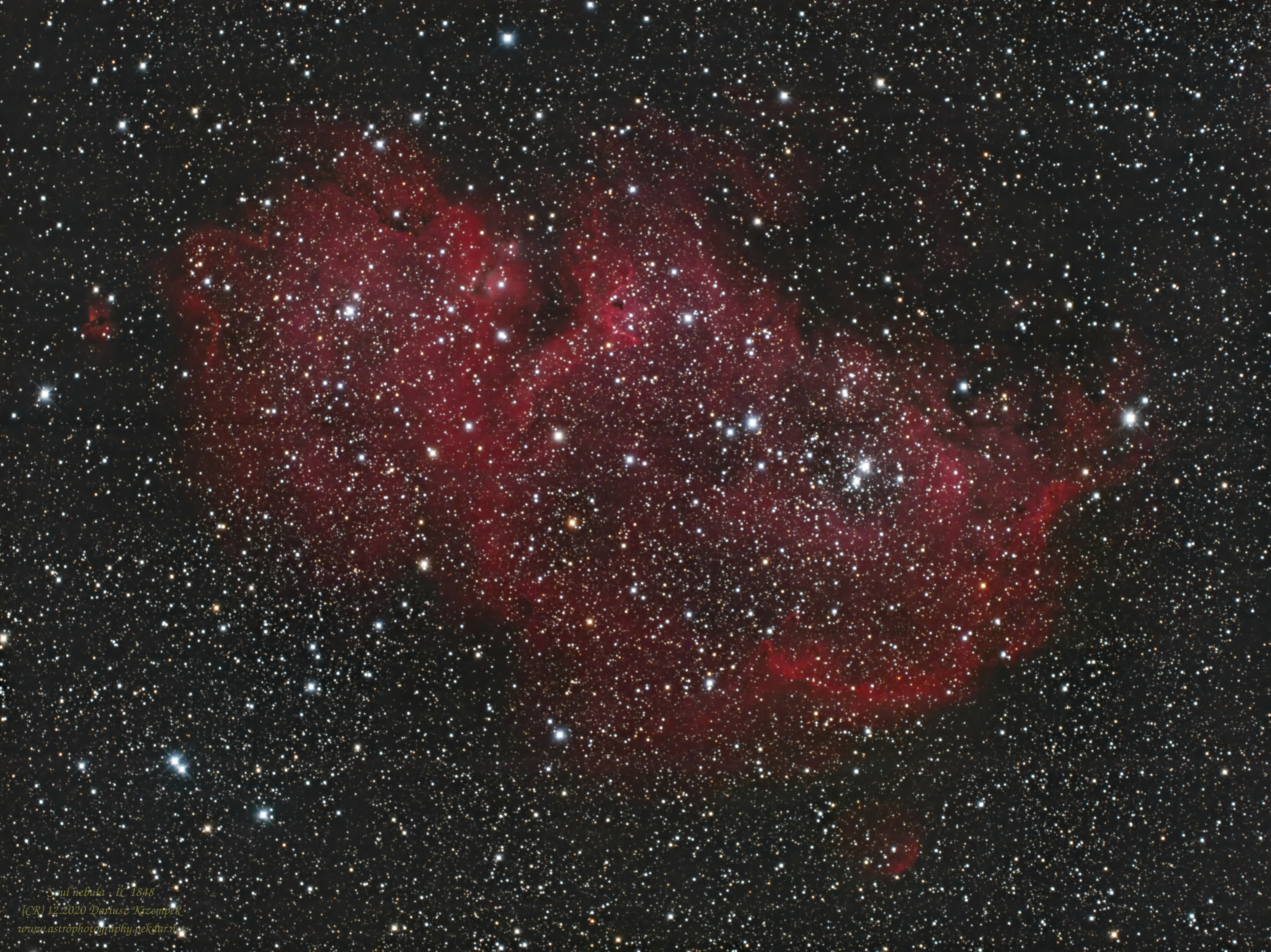
IC 1848 – Soul Nebula
Source: https://en.wikipedia.org/wiki/Westerhout_5