
Anatomy of a Giant
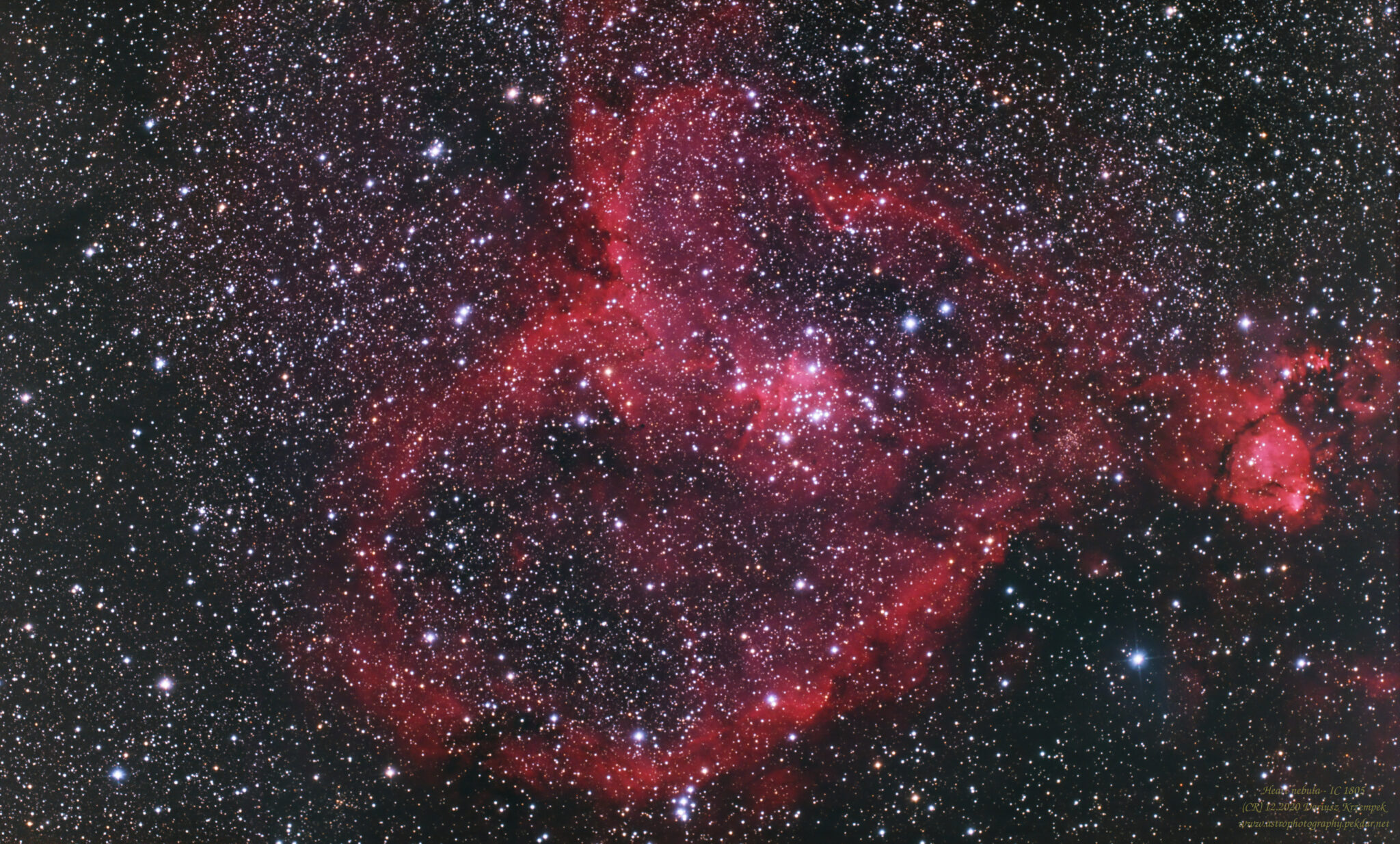
IC 1805, commonly known as the Heart Nebula, is in reality a vast star-forming region (H II region) spanning nearly 2.5 degrees across the sky (equivalent to five full Moons). Located approximately 7500 light-years from Earth in the Perseus Arm of our galaxy, this nebula is a classic example of the interaction between young, massive stars and their parent gas cloud.
The brightest part of the nebula (a knot at its western edge) is separately classified as NGC 896, because it was the first part of the nebula to be discovered. The nebula’s intense red output and its morphology are driven by the radiation emanating from a small group of stars near the nebula’s center. This open cluster of stars, known as Collinder 26 or Melotte 15, contains a few bright stars nearly 50 times the mass of our Sun, and many more dim stars that are only a fraction of our Sun’s mass.
The Engine
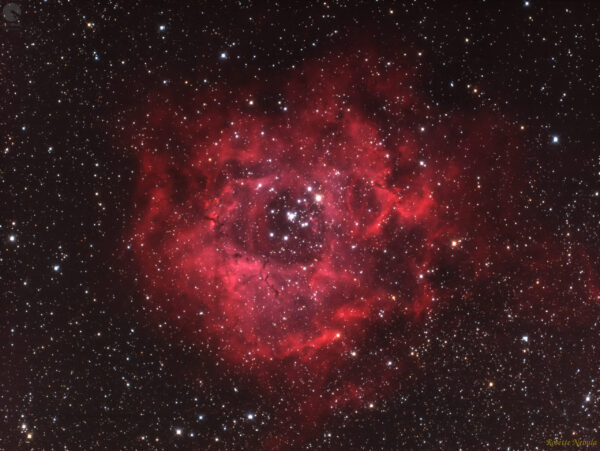
Melotte 15 The key to understanding this image lies at the very center of the nebula. The bright open cluster visible in the core is Melotte 15. It contains several ultra-massive O-type stars (with masses reaching up to 50 times that of the Sun). This is not a peaceful neighborhood. These stars emit powerful stellar winds and intense UV radiation.
Excavation: The stellar wind has literally “blown out” the gas from the center of the nebula, creating the characteristic void around the cluster.
Ionization: UV radiation strips electrons from hydrogen atoms in the surrounding cloud. When these electrons recombine (drop to lower energy levels), they emit photons at a specific wavelength – primarily the H-alpha line (). It is this physical process that accounts for the deep red color dominating the image.
Dust Structures and “Elephant Trunks” Contrasting with the bright hydrogen plasma, dark lanes of interstellar dust (silicates and carbon) are visible in the image. Note the pillar-like structures (often called “elephant trunks”) pointing towards the center. These are denser pockets of gas and dust that are resisting the destructive force of the stellar wind from Melotte 15. Inside these dark cocoons, processes of gravitational collapse are still ongoing – new stars are being born there.
Technical Aspect
Capturing IC 1805 required a camera sensitive to the H-alpha band or a modified DSLR/Mirrorless, as standard infrared cut filters in consumer equipment block most of the signal from this object. Due to its enormous angular size, this image required either short focal length optics or a mosaic technique.
On the left side of the photo you can see an interstellar dust (grey, dark grey).
The photo is the result of combining two different photo sessions but in the same location. The frame is not proportional, it is too wide. However, I didn’t want to crop it because of the interstellar dust revealing on the left side of the frame. Personally, I liked this photo very much and I think it is better than the previous one, which was made only from one photo session.

IC 1805 – Heart Nebula