

17 Cygnus – Beauty in Geometry
In astrophotography, we often seek expansive structures, but it is double systems like 17 Cygnus (HR 7534) that teach us about the resolution limits of our equipment. Located in the heart of Cygnus, this star is a fascinating system captured here in a wide-field shot, allowing for the inclusion of both the primary target and its interesting surroundings.
Analysis of Enlargements (Crops):
-
Crop 1: The 17 Cygnus System (Components A and B) This enlargement features the primary target of the session. 17 Cygnus is an F5-type star with a magnitude of approximately 5.0. Its companion (component B) is significantly dimmer (around 8-9 mag), meaning that overexposure can easily cause the primary star’s glare to “swallow” it. The separation is roughly 26 arcseconds, making it a rewarding target even for smaller telescopes.
-
Crop 2: Neighboring Visual Double The second crop highlights another pair of stars within the same field of view (likely a background double or a wide optical pair). Comparing these two crops allows us to see the difference in brightness and stellar color—17 Cygnus’s hue is noticeably warmer, a result of its specific surface temperature.
Technical Challenges
Capturing double stars requires perfect focus (where the Bahtinov mask is indispensable) and steady atmospheric conditions (seeing). If the atmosphere is turbulent, the two distinct points of light blur into a single ellipse. In this image, the separation was maintained, proving the quality of the instrument’s collimation and the stability of the night.
Photographs taken on: March 2019.
Composition: DSS (10 best frames and Dark + Bias frames)
Processing: GIMP v2.10.6 + add-ons (Linux)
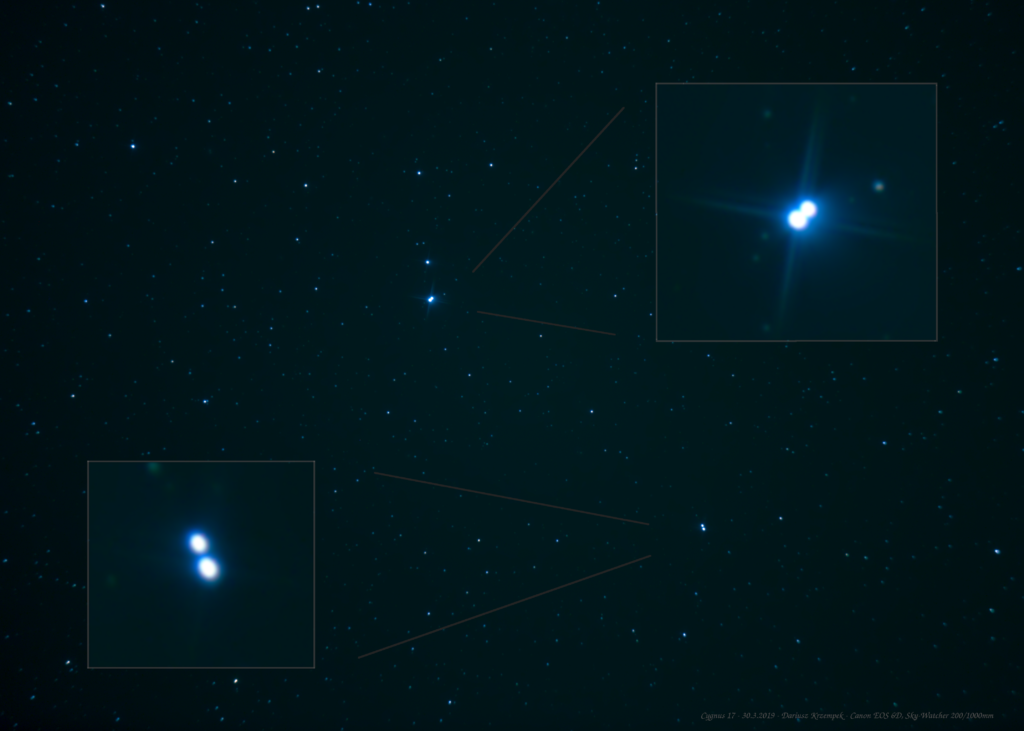 Cygnus 17 – the right upper magnification – Brightness is 5 Mag., The double system of stars of the night sky in the constellation of the swan.