
The Heart in the Heart The Melotte 15
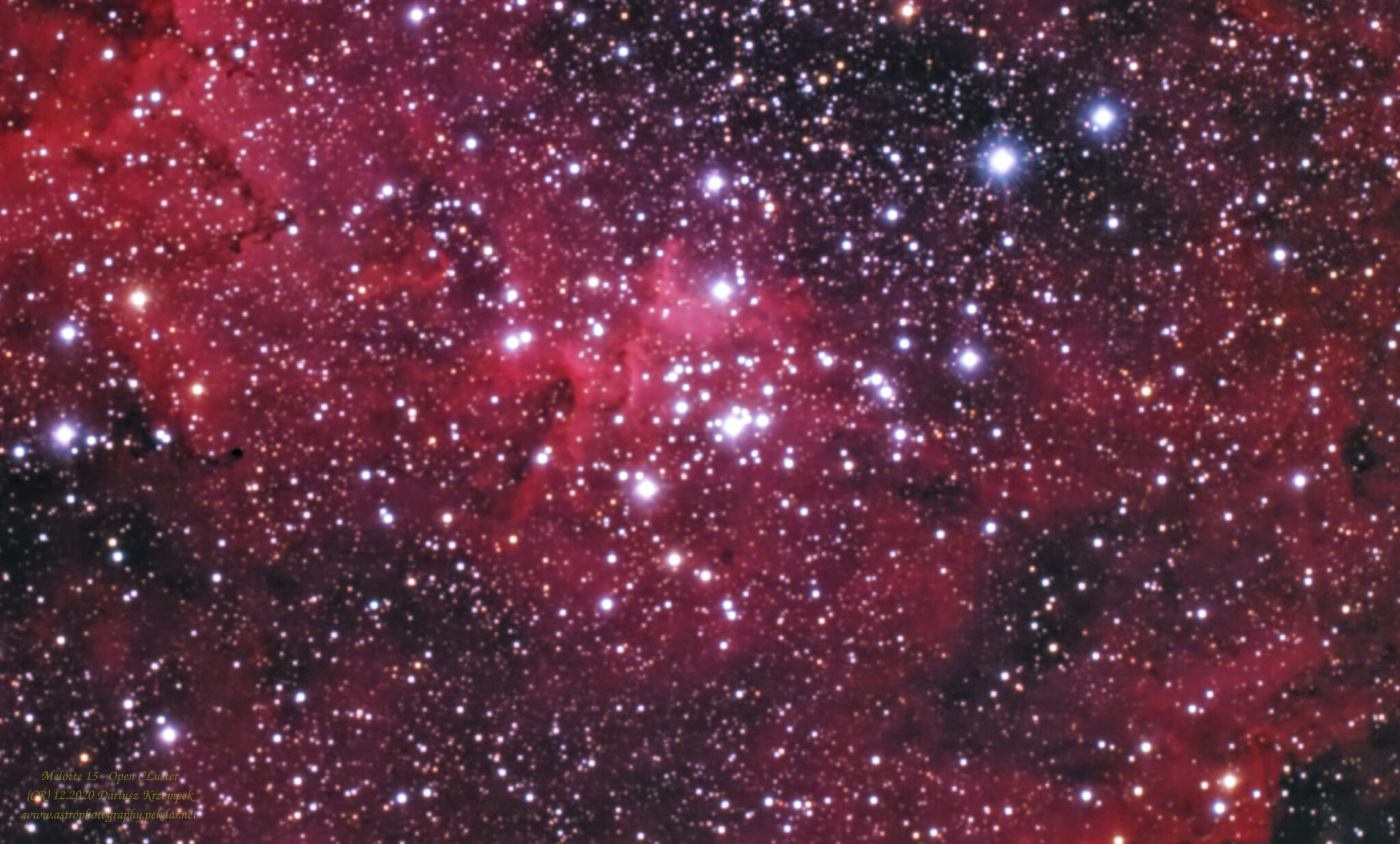
Melotte 15 cluster is the energetic core of the vast emission complex IC 1805 (the Heart Nebula). Rather than being just a collection of bright points, it is an astrophysical laboratory demonstrating how massive stars sculpt matter on a galactic scale. The cluster is exceptionally young – its age is estimated at only 1.5 million years, making it one of the youngest, actively studied regions in the Milky Way.
O-Type Stars: A Short and Turbulent Lifespan Key to understanding Melotte 15 are its brightest and most massive components, including several O-type giants and numerous B-type stars.
-
O-Type Stars: They are extremely hot (surface temperatures can exceed ), possess immense masses (up to 50 solar masses), and live very short lives (only a few million years).
-
UV Emission: Due to their high temperature, they emit enormous amounts of ultraviolet (UV) radiation, which is the primary ionizing agent for the surrounding hydrogen gas, causing the characteristic red glow of IC 1805.
-
Stellar Wind: These stars also eject powerful stellar winds that have, like a giant broom, swept the gas out of the nebula’s center, creating the visible cavity around Melotte 15.
Located in the constellation Cassiopeia, approximately 6,000 light-years from Earth. It is an extremely young star cluster with an average age of 1.5 million years. Located very close to the center of the Heart Nebula, precisely it is about 50 light-years ahead of the nebula. Melotte 15, contains a few bright stars nearly 50 times mass of our Sun, and many more dim stars that are only a fraction of our Sun’s mass. Melotte 15 is one of the association core clusters Cas OB6. This cluster is more nebular in nature.

Melotte 15 – Open Cluster in the center of the Heart Nebula
Maturity and the End of the Cycle
The presence of such massive and hot stars means the cluster is currently experiencing its most intense period. However, its dominance won’t last long. O-type stars consume their nuclear fuel thousands of times faster than the Sun. Within the next few million years, they will exhaust their hydrogen and explode as supernovae, leading to the dispersal of the remaining nebula and the eventual break-up of the cluster itself.
Technical Challenge: Brightness Balance
Astrophotography of Melotte 15 presents a challenge because the brightness of these central, massive stars is thousands of times greater than the subtle nebular structures. This demands precise HDR (High Dynamic Range) processing and careful reduction of the star halos to avoid “blowing out” their cores while simultaneously preserving detail in the background.